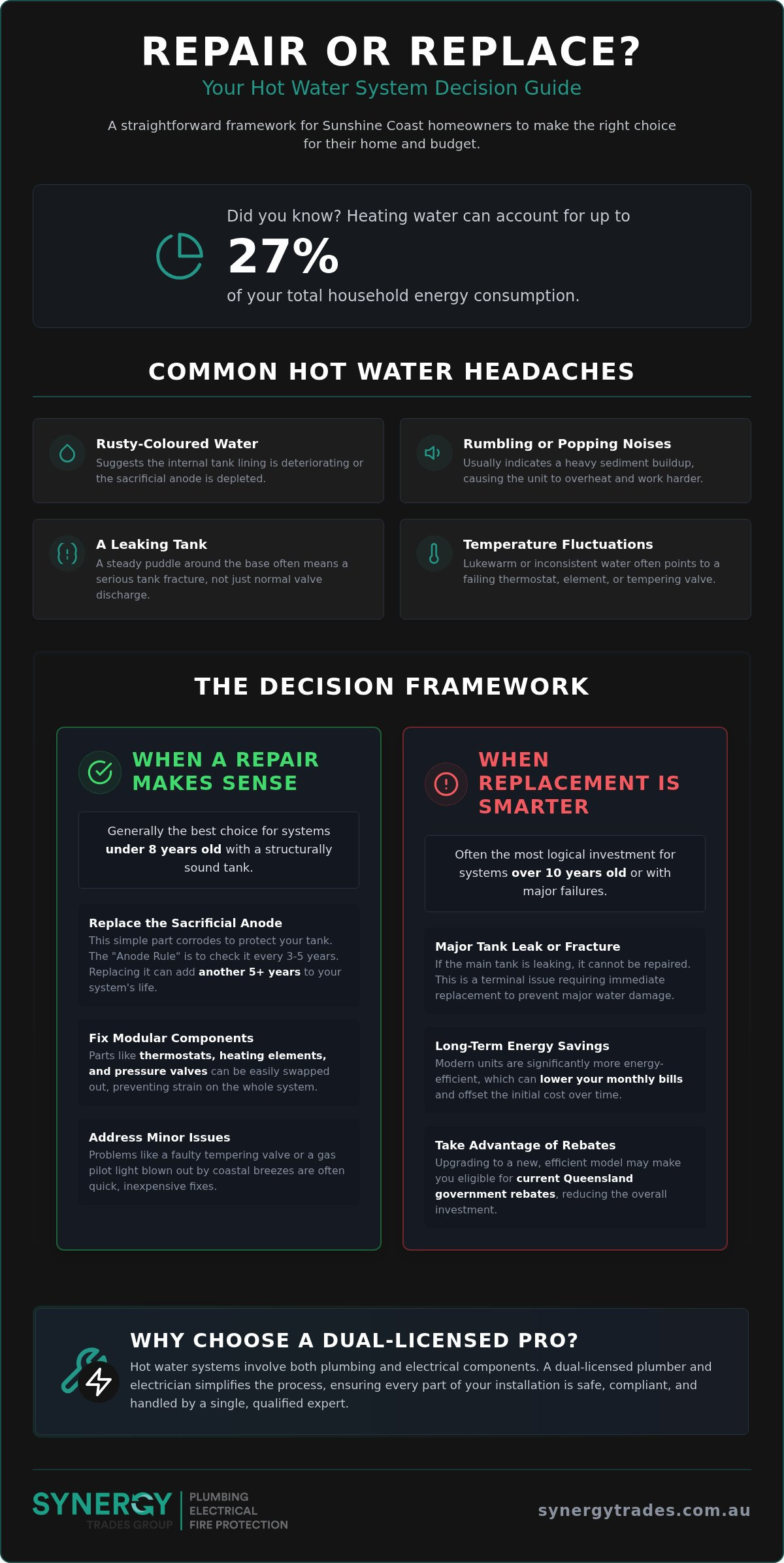
Did you know that heating your water can account for up to 27% of your total household energy consumption? It’s a significant portion of your monthly expenses, so when your unit starts acting up, it’s natural to feel a bit of dread. Whether you’ve discovered a puddle under the tank or you’re tired of shivering through unexpected cold showers, the pressure to decide whether to repair or replace your hot water system is real. You’re likely wondering if a quick fix will buy you another five years or if you’re simply delaying an inevitable, more expensive breakdown.
We understand that you want a reliable hot water supply without the stress of hidden costs or confusing trade jargon. You deserve clear advice from local professionals who know the Sunshine Coast’s unique water conditions. This guide provides a straightforward framework to help you make the right choice for your home and your budget. We’ll explore the “Rule of 10,” the impact of local mineral levels on your system’s lifespan, and how you can take advantage of current Queensland rebates to keep your running costs as low as possible.
Key Takeaways
- Identify early warning signs like fluctuating temperatures and strange noises to prevent a minor issue from becoming a costly flood.
- Master the “Rule of 10” decision-making framework to determine whether it is more cost-effective to repair or replace your hot water system.
- Discover how replacing a simple sacrificial anode can significantly extend the life of your tank for a fraction of the cost of a new unit.
- Learn why choosing a dual-licensed plumber and electrician simplifies the process and ensures every technical component is safe and compliant.
- Compare the long-term running costs of modern units to see how an energy-efficient upgrade could lower your monthly household bills.
Common Hot Water Headaches: Identifying the Problem Early
Waking up to an icy shower is never the start you want to your day. On the Sunshine Coast, our outdoor units face the added challenge of salty coastal air, which can accelerate external corrosion on the casing and connections. Before you panic, it’s helpful to understand the basics of how water heaters work so you can spot the difference between a minor component failure and a terminal tank issue. Deciding whether to repair or replace your hot water system often hinges on a clear diagnosis of these early warning signs.
Common symptoms include rusty-coloured water, which often suggests the internal lining of your tank is deteriorating or the sacrificial anode has been spent. You might also hear strange rumbling or popping noises. These sounds usually indicate a heavy buildup of sediment at the bottom of the tank, which causes the unit to overheat and work much harder than it should. This inefficiency doesn’t just risk a breakdown; it also drives up your monthly electricity bills. Since hot water can account for up to 27% of a household’s energy use, these “headaches” are often expensive if left ignored. If you want to audit your system’s health before things get worse, our hot water system failure checklist for Sunshine Coast homeowners walks you through every warning sign to watch for.
Before you call out a tradie, you can safely run through this “No Hot Water” checklist:
- Check your switchboard for a tripped safety switch or a blown fuse.
- Verify that your gas supply hasn’t been turned off or interrupted.
- Look for the isolation valve and ensure it hasn’t been accidentally bumped shut.
- Check the Temperature Pressure Relief (TPR) valve to see if it is leaking excessively.
Is Your Hot Water Tank Leaking?
Not every drop of water signifies a disaster. It is normal for the TPR valve to discharge a small amount of water into the drain line during the heating cycle to manage pressure. However, if you see a steady stream or a growing puddle around the base of the tank that never dries up, you likely have a serious tank fracture. A small puddle today could lead to a major flood tomorrow. If you spot a significant leak, turn off the water supply and the power or gas immediately to prevent further damage.
Temperature Troubles and Pilot Lights
If your water is lukewarm rather than hot, the culprit is often a faulty tempering valve. These valves are mandatory in Queensland to ensure water delivered to bathrooms stays below 50°C to prevent scalding. For gas systems, our breezy coastal conditions can sometimes blow out the pilot light, especially if the unit is in an exposed position. While a simple thermostat adjustment might solve some minor issues, consistent temperature fluctuations usually mean a heating element or thermostat is failing and requires professional attention.
When a Repair Makes Sense: Saving Your Current System
Many homeowners assume a leak or a sudden lack of heat means their unit is destined for the scrap heap. That isn’t always the case. If your tank is structurally sound, a targeted repair is often the most sustainable and budget-friendly path. Deciding whether to repair or replace your hot water system usually comes down to the condition of the internal tank versus the components that serve it. Most of the mechanical parts on a hot water unit are modular, meaning items like thermostats, heating elements, and pressure valves can be swapped out easily by a professional.
By replacing these parts as they wear, you can effectively double the lifespan of a standard electric storage unit. Proactive maintenance prevents the system from working under unnecessary strain. This keeps your unit running longer and delays the need to invest in a brand-new energy-efficient model before you’ve seen a full return on your current one. For units under 8 years old, a repair is almost always the most cost-effective choice. If you want to understand exactly what’s involved in keeping your unit running, our comprehensive guide to hot water system repairs on the Sunshine Coast covers common faults, costs, and when a fix is genuinely worth it.
Replacing the Sacrificial Anode
The Sunshine Coast has a unique mineral profile in its water supply that can be quite aggressive on metal tanks. This is where the sacrificial anode plays its vital role. A sacrificial anode acts as the “lightning rod” for tank corrosion. It’s a magnesium or aluminium rod designed to rust away so your steel tank doesn’t have to. We recommend the “Anode Rule”: have it checked every 3 to 5 years. If the rod is more than 50% depleted, replacing it can add another half-decade to your system’s life. It’s one of the simplest ways to protect your investment from the inside out.
Valve and Element Repairs
Another common fix involves the Temperature Pressure Relief (TPR) valve. If this valve fails, it can’t vent excess pressure, which puts the entire tank at risk of structural failure. Similarly, if you notice your hot water running out faster than usual, a burnt-out heating element is often the culprit. Swapping an element is a straightforward task for a qualified technician. Because we hold both plumbing and electrical licences, our team can diagnose whether the fault lies with a wire or a pipe in a single visit. If you’re unsure of the state of your unit, our team can help you organise a professional inspection to see if your system can be saved.
The Tipping Point: When Replacement is the Smarter Investment
Every appliance has a natural lifecycle, and hot water units are no exception. While our team always looks for ways to extend the life of your unit, there comes a moment where continuing to patch up an old system becomes a case of throwing good money after bad. To help our Sunshine Coast neighbours navigate this, we use the “Rule of 10.” If your storage tank is over a decade old, it is statistically likely to be on borrowed time. At this stage, the internal components have endured years of thermal expansion and contraction, making a total failure much more probable. When you are deciding whether to repair or replace your hot water system, the age of the unit is your most reliable primary indicator.
Calculating the return on investment (ROI) is the next logical step. We generally advise that if a single repair cost approaches 50% of the price of a new installation, replacement is the wiser financial move. You also need to consider the “domino effect.” Often, replacing a heating element in a twelve-year-old system simply increases the internal pressure, which then causes the aging thermostat or the tank itself to fail shortly after. Beyond the immediate repair bill, consider the hidden cost of inefficiency. Older units are often “energy guzzlers” that lack the advanced insulation found in modern models. Since hot water accounts for up to 27% of your household energy use, an inefficient unit can add hundreds of dollars to your annual utility costs.
Signs Your Tank is Beyond Saving
Some problems simply cannot be fixed. If the internal cylinder of a glass-lined or copper tank fractures, it is impossible to weld it back together. A leaking tank is a terminal condition. You might also notice a constant cycle of component failures where you are calling a tradie every few months. This pattern suggests the system’s overall integrity has declined. In these cases, a new installation provides the peace of mind that comes with a fresh manufacturer’s warranty and a reliable hot water supply.
Upgrading for the Future
Choosing to replace your unit is an opportunity to right-size your system for your current lifestyle. If your family has grown, moving to a larger capacity tank or a high-efficiency heat pump can prevent those morning arguments over who used all the hot water. Modern heat pumps are particularly effective in our warm Sunshine Coast climate, often qualifying for federal Small-scale Technology Certificates (STCs) that provide a point-of-sale discount between $900 and $1,200. Additionally, the Queensland Government’s Climate Smart Energy Saver program offers rebates of up to $1,000 for eligible energy-efficient upgrades. These incentives, combined with lower running costs on off peak hot water tariffs, often make a new system the most sustainable choice for your back pocket.
Plumber or Electrician? Solving the Hot Water Dilemma
One of the most frustrating aspects of a cold shower is the confusion over who to call. Hot water systems are the “hybrids” of the home maintenance world; they rely on a complex interaction between water pressure and electrical power. Traditionally, this creates a split in the trade industry. You call a plumber for the “wet bits” and an electrician for the “wires.” If you call a plumber for a problem that turns out to be a burnt-out circuit breaker, you are often left paying a call-out fee just to be told to call someone else. This double-handling is a common pain point for Sunshine Coast residents trying to decide whether to repair or replace your hot water system. For a deeper look at how to navigate these decisions confidently, our homeowner’s guide to hot water system repairs on the Sunshine Coast explains how to spot common faults and find reliable, fairly priced help fast.
At Synergy Trades Group, we’ve eliminated this guesswork. Because we hold dual licensing in both plumbing and electrical work, we provide a “one call does it all” service. We don’t just look at the pipes; we look at the whole system. This integrated approach ensures that we diagnose the root cause of the failure immediately, saving you time and the expense of multiple service visits. Whether your issue is a pipe that has burst or a thermostat that has failed, our team has the expertise to resolve it in a single trip.
When the Problem is Electrical
If your safety switch trips every time the hot water unit kicks in, you almost certainly have an electrical fault. This is often caused by a corroded heating element where water has breached the protective casing and touched the electrical wire. Thermostat failures are another common electrical issue; they can cause the water to become dangerously hot or not heat up at all. It is critical to remember that DIY electrical work is illegal in Queensland and incredibly dangerous near water. A licensed electrician is the only person qualified to safely test and replace these high-voltage components.
When the Problem is Plumbing
Visible water leaks or a sudden drop in water pressure are clear indicators that the plumbing side of the system is failing. External pipe bursts can occur due to age or environmental factors, while internal tank fractures usually mean the unit is beyond help. We also frequently deal with tempering valve issues. These valves are essential for meeting Australian Safety Standards (AS3500), as they prevent hot water from reaching temperatures that could cause scalding in your bathroom. If you suspect a leak but can’t see the source, our specialised water leak detection services can identify hidden issues before they cause structural damage to your home.
Don’t waste time and money juggling multiple trades. If your hot water is acting up, contact Synergy Trades Group today for a comprehensive diagnosis and a reliable solution from our dual-licensed experts.
Expert Hot Water Solutions for Sunshine Coast Homes
When you’re trying to decide whether to repair or replace your hot water system, you need a partner who prioritises your best interests over a quick sale. At Synergy Trades Group, we operate with a “Repair First” mentality. This means we won’t push for a new installation if a cost-effective repair can safely extend the life of your unit for several more years. We understand that home maintenance is often stressful, especially when it involves the dual complexities of water and electricity. Our team is here to simplify that process by offering a single, reliable point of contact for every aspect of your hot water needs.
The Synergy difference lies in our dual-trade expertise. Because we hold both plumbing and electrical licences, we eliminate the need for you to coordinate two separate tradies. This integrated approach doesn’t just save you time; it ensures that every connection, from the water inlet to the heating element, is handled with professional precision. Whether you eventually choose to repair or replace your hot water system, we ensure the result is safe, compliant, and efficient. We are also deeply familiar with the Sunshine Coast’s specific environmental challenges. From the high humidity in Buderim to the salty air of Mooloolaba, we recommend and install units that are built to withstand our local conditions. Our commitment to transparency means you’ll receive clear, fixed-fee advice without hidden surprises or high-pressure tactics.
Our Seamless Process
We’ve refined our service to be as low-friction as possible for our clients. It begins with a thorough inspection where we assess the structural integrity of your tank and the performance of its mechanical components. If a replacement is necessary, we help you navigate the latest energy-efficient technologies. We ensure your new system matches your household’s peak demand while staying within your budget. We manage the entire installation, including the required tempering valves to meet Australian Safety Standards. Importantly, we ensure all work complies with the Plumbing and Drainage Act 2018 and local Sunshine Coast Council regulations, providing you with all the necessary certification for your records.
Why Local Expertise Matters
Experience counts when it comes to the longevity of your home’s infrastructure. Paul and Lynda lead our family-owned business with over 70 years of combined industry experience. We aren’t a faceless national franchise; we are your neighbours, and we take genuine pride in the workmanship we provide to our local community. Choosing a local expert means you’re supporting a business that understands the specific water mineral profiles of the Coast and cares about the long-term safety of your property. We don’t just fix pipes. We secure your peace of mind. If you’re ready for a reliable solution, book your hot water inspection with the Sunshine Coast experts today!
Secure Your Hot Water Future Today
Deciding whether to repair or replace your hot water system doesn’t have to be a source of stress. By applying the “Rule of 10” and monitoring the health of your sacrificial anode, you can move from technical confusion to a clear, cost-effective plan. Most systems under eight years old are excellent candidates for a targeted repair, while older units often hide high running costs that make an upgrade the smarter investment for your back pocket.
At Synergy Trades Group, we take the guesswork out of the equation. As a family-owned business operated by Paul and Lynda, we bring over 70 years of combined industry experience to every Sunshine Coast property we visit. Our dual licensing in both plumbing and electrical work ensures that we diagnose the root cause immediately, saving you from the frustration of multiple call-out fees. We prioritise your peace of mind by providing honest, transparent advice you can trust.
Ready to stop the cold showers for good? Get your hot water sorted by the Sunshine Coast experts at Synergy Trades Group. We look forward to helping you restore a reliable, efficient hot water supply to your home.
Frequently Asked Questions
Do I need a plumber or an electrician to fix my hot water system?
You generally need both trades because hot water systems combine plumbing and electrical components. A plumber handles the water connections and valves, while an electrician is required for the thermostat and heating element wiring. Choosing a dual-licensed professional avoids the hassle and expense of booking two separate tradies for a single diagnosis.
How long does a typical hot water system last on the Sunshine Coast?
A typical hot water system on the Sunshine Coast usually lasts between 8 and 12 years. Our coastal environment, with its salty air and specific mineral content in the water, can lead to faster corrosion on external casings and internal tanks. Regular maintenance, such as checking the sacrificial anode, is the most effective way to reach the upper end of this lifespan.
Is it worth repairing a hot water system that is 10 years old?
It is rarely worth repairing a unit over 10 years old if the fix is significant. Once a system reaches this age, the likelihood of a “domino effect” failure increases, where one repair is quickly followed by another. If the repair cost exceeds 50% of a new installation, we recommend you repair or replace your hot water system by choosing a modern, efficient upgrade.
Why is my hot water system leaking from the top?
Leaks from the top of the tank are often caused by loose cold or hot water inlet fittings, or a faulty Temperature Pressure Relief (TPR) valve. While some of these are simple tightening jobs, water pooling on top of the unit can also indicate a fracture in the internal cylinder. You should have this inspected immediately to prevent a major flood or structural water damage.
How much does it cost to replace a hot water system in Australia?
The average cost to replace a hot water system in Australia typically ranges from $1,400 to $4,500. This industry average varies based on the unit type, such as electric, gas, or heat pump, and the complexity of the installation. While upfront costs are a factor, modern energy-efficient systems often qualify for government rebates that help offset the initial investment.
Can I change my own hot water heating element?
No, you cannot legally change your own heating element in Queensland. Under the Plumbing and Drainage Act 2018, all work on hot water systems must be performed by a licensed professional. Attempting a DIY fix is dangerous due to the high voltage involved and will void your manufacturer’s warranty and potentially your home insurance.
What is a sacrificial anode and how often should it be replaced?
A sacrificial anode is a magnesium or aluminium rod that protects your steel tank from rusting by corroding in its place. To effectively extend your tank’s life, you should have the anode checked and replaced every 3 to 5 years. This simple maintenance task is far cheaper than replacing an entire ruptured tank.
Will a new hot water system lower my electricity bills?
Yes, a new system can significantly lower your monthly costs, as hot water heating accounts for up to 27% of an average household’s energy consumption. Modern heat pumps and high-efficiency electric storage units use advanced insulation and technology to retain heat longer. Upgrading allows you to take advantage of off peak hot water tariffs and current Queensland energy rebates to maximise your long-term savings.