What if the secret to a lower electricity bill isn’t about when you shower, but how much water your tank can actually hold? Most Sunshine Coast homeowners feel the sting of rising quarterly electricity bills, especially when a traditional electric storage system can cost up to A$1,500 a year to run. It’s frustrating to pay a premium just to keep the water warm, yet the fear of a mid-lather cold snap often stops people from switching to off peak hot water. You want to save money, but you also need to know the hot water will be there when your family needs it most.
This guide explains exactly how off-peak tariffs work under the latest 2026 Queensland regulations to help you slash running costs by up to 50%. We’ll break down the practical differences between Tariff 31 and Tariff 33, explore how the new Solar Sharer Offer provides free power windows, and help you choose the right configuration for your specific lifestyle. By the end, you’ll have a clear plan to reduce your energy spend while maintaining the reliable, steaming-hot showers your household deserves.
Key Takeaways
- Understand the practical differences between Tariff 31 and Tariff 33 to choose the best balance of savings and availability for your home.
- Learn how switching to off peak hot water can slash your heating costs by up to 50% without compromising your morning routine.
- Discover why storage tank capacity is the “battery” of your system and how to size it correctly to avoid running out of water during peak times.
- Identify common technical issues like blown elements and learn how a booster switch can act as a safety net for your family.
- Gain peace of mind by learning how a professional system optimisation ensures your setup meets local Energex requirements and runs at peak efficiency.
Understanding Off-Peak Hot Water: How It Works in Queensland
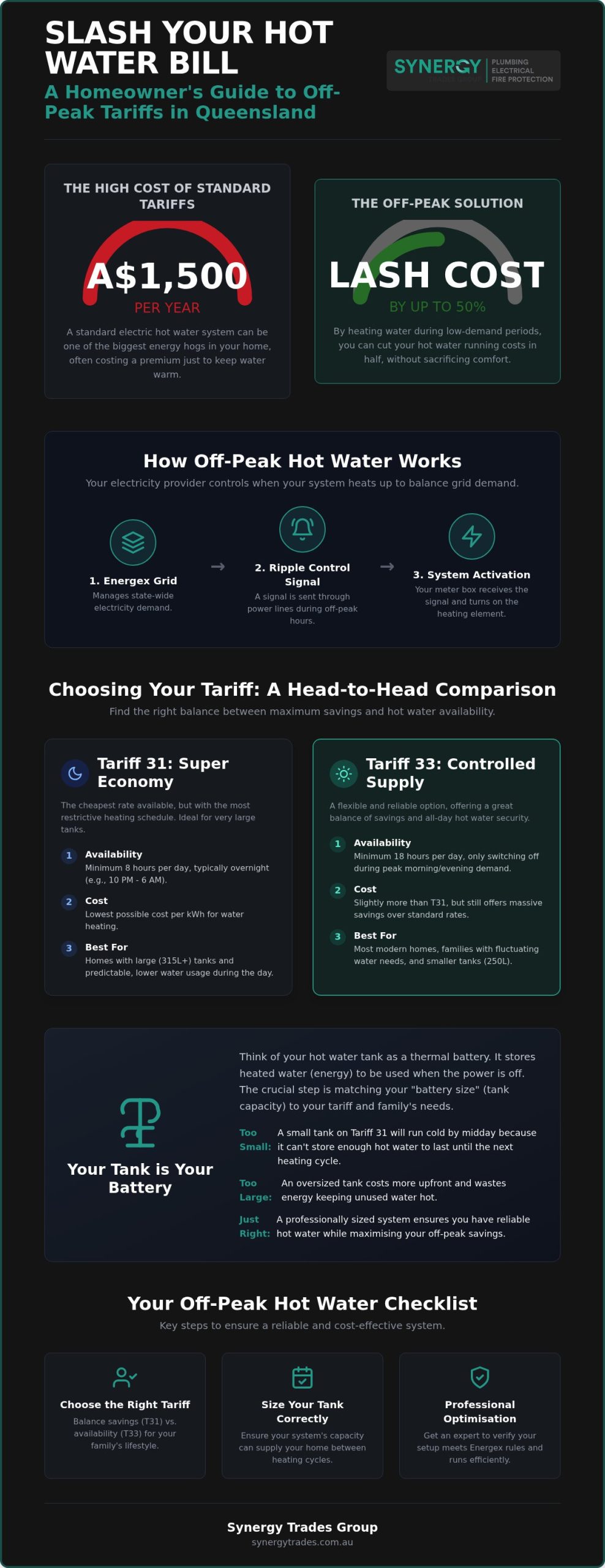
At its core, off peak hot water is a simple strategy to manage peak and off-peak electricity demand. Electricity retailers want to avoid a situation where every household draws massive amounts of power at the same time, which usually happens during the evening rush. To encourage you to use power when the grid is quiet, they offer “controlled load” tariffs at a much lower rate than your standard light and power circuit. It’s a win-win: the grid stays stable, and your quarterly bill stays manageable.
Your home’s switchboard likely contains a dedicated meter or a specific circuit for this purpose. Unlike your toaster or TV, which you can turn on whenever you like, your hot water system only receives power during specific windows dictated by the network provider, Energex. This is why it’s called a “controlled” load; the network controls the supply, and you get the savings in return. This differs from “shoulder” periods, which are simply times of day when rates are slightly lower but power is still always available. With a controlled load, the power is physically cut off when the window closes.
Tariff 31 vs. Tariff 33: The Energex Breakdown
Tariff 31 is the “super economy” night rate. It’s the most affordable option but also the most restrictive. Power is typically only available for about eight hours, usually between 10:00 PM and 6:00 AM. This was the standard for older Sunshine Coast homes with massive 400-litre tanks. If you have a large family but a smaller tank on this tariff, you’ll likely run out of hot water by lunchtime because the system won’t “top up” until the following night.
Tariff 33 is the “controlled supply” option. It costs slightly more than T31 but is available for at least 18 hours a day. It only switches off during the highest peak periods in the morning and evening. Most modern Sunshine Coast builds are set up on Tariff 33 because it offers a better balance of savings and reliability, especially for households with fluctuating water use or smaller storage tanks.
How Your Hot Water System “Knows” When to Heat
It isn’t magic or a simple clock that triggers your heater. Inside your meter box sits a device called a ripple control receiver. This unit listens for a high-frequency signal sent through the power lines by Energex. When the signal arrives, the receiver closes the circuit and allows your hot water element to start heating. It’s a robust, mechanical way to manage the grid’s load from a central location.
This physical connection means your system doesn’t react to you turning on a tap. It only reacts to the grid’s capacity and the specific signal from the network. This is why sizing your tank correctly is so vital; you need enough stored “thermal energy” to last until the next time Energex sends that signal to turn the power back on. Without a professional check of your setup, you might be on the wrong tariff for your tank size, leading to those dreaded cold showers.
The Financial Benefits: Is Off-Peak Actually Cheaper?
Heating water is often the single largest expense in an Australian home. It’s a constant demand that works quietly in the background, but it can account for roughly 25% to 30% of an average household’s energy use. For a typical Sunshine Coast family of four, this translates to hundreds of dollars every quarter. By moving this heavy load from the standard Tariff 11, which is the flat rate you pay for lights and appliances, to a controlled load like Tariff 31 or 33, you are essentially buying your energy at wholesale prices.
The financial impact is substantial. Research indicates that connecting to off peak hot water can reduce your heating costs by up to 50%. While Tariff 11 provides the convenience of power 24 hours a day, it also leaves you vulnerable to peak demand charges during the evening rush. Shifting your heating to the middle of the night or midday windows helps flatten the grid’s load and protects your wallet from the highest price tiers. In the 2026-2027 period, regional Queensland households on standard tariffs are already seeing savings of around A$212 per year, but those who optimise their hot water usage often see much deeper cuts to their quarterly statements.
Calculating Your Potential Savings
To see if you’re already saving, look at the back of your electricity bill under the “Usage” section. If you only see Tariff 11, you’re paying the maximum rate for every litre of hot water. A family of four using a traditional electric storage system might spend between A$1,200 and A$1,500 annually on hot water alone. Switching to Tariff 33 could save that same family significant amounts over the life of the system. The “break-even” point usually comes down to whether your current tank is large enough to handle the restricted heating windows without needing a costly upgrade.
Hidden Costs to Consider Before Switching
While the lower rates are attractive, there are initial setup factors to keep in mind. You’ll need a qualified professional to ensure your switchboard is configured for controlled loads, which may involve installing a ripple controller or a second meter. Additionally, a tank that is too small might be unsuitable for off-peak operation. If a small 125-litre tank is forced onto Tariff 31, it will likely run cold before breakfast, leading to high-stress mornings for the whole family. Balancing the long-term value of system efficiency against these setup costs is where professional hot water repairs and audits become invaluable, ensuring you don’t spend more on modifications than you’ll save on power.
The Storage Dilemma: Why Tank Size Is Critical for Off-Peak
Think of your hot water tank as a thermal battery. Instead of storing electricity like a lithium-ion unit, it stores heat in the form of water. This concept is the backbone of off peak hot water success. If your “battery” is too small, it runs flat before the day is over, leaving you with a cold shower when you least expect it. The number one reason homeowners struggle with off-peak isn’t the tariff itself; it’s a mismatch between their daily water usage and the physical capacity of their storage tank.
The “reheat time” factor is where many households get caught out. If you’re on a restrictive tariff and use your entire hot water supply by 9:00 AM, the system won’t simply kick back in to help with the lunch dishes. It sits idle until the next signal from the grid arrives. This makes the storage volume your only safety net. While a standard electric system on Tariff 11 heats water almost as soon as the temperature drops, an off-peak system must be large enough to carry you through those long gaps when the power is physically disconnected.
Matching Your Family Size to the Right Tank
For a household of one or two people, a 250-litre tank on Tariff 33 often provides plenty of breathing room. However, larger Sunshine Coast families need a more robust solution. If you want the maximum savings of Tariff 31, a 315-litre or 400-litre tank is the gold standard. These larger volumes allow you to heat the water once overnight and draw from that “battery” throughout the following 16 hours. If you currently have a small tank and find yourself constantly running out, you may need to repair or replace hot water system units to ensure your storage capacity actually matches your lifestyle. For coastal properties in particular, understanding what a hot water installation Caloundra residents can rely on involves selecting materials that withstand the salt air environment while meeting your capacity needs.
The Risk of Cold Showers: Managing Your Hot Water Budget
Managing your hot water is easier when you understand stratification. Within your tank, hot water naturally rises to the top while cold water sits at the bottom. This means the water coming out of your shower stays hot until the very end of the supply. You can protect this “hot zone” by installing low-flow showerheads, which can extend your storage duration by up to 30%. Be mindful of high-draw appliances too. Running a dishwasher or a washing machine on a hot cycle in the middle of the day can drain your thermal battery prematurely. By shifting these tasks to the evening or using cold-water settings, you preserve the hot water for what matters most: the people in your home.
Troubleshooting and Overrides: When the Water Runs Cold
Waking up to a lukewarm shower is a stressful start to the day. When you rely on off peak hot water, troubleshooting is slightly different than a standard 24/7 system. You need to determine if the issue is a mechanical failure within the tank or a supply issue from the Energex grid. Generally, if your neighbours have power but your tank is cold, the problem lies with your heating element or thermostat. If the whole street is dark, it’s a network fault that usually resolves once the grid is back online.
Some modern setups include a manual booster switch. This allows you to override the off-peak timer and draw power from the more expensive Tariff 11 circuit. It’s a handy feature when you have houseguests and higher demand. However, relying on this “boost” too often will quickly erase the savings you’ve gained. If you find yourself hitting that button every afternoon, your off peak hot water system is likely struggling with a tank that’s too small for your current needs.
How to Safely Manage a Hot Water Shortage
Before you panic, check your switchboard. Look for the circuit breaker labelled “Hot Water” or “Controlled Load.” If it has tripped, you can try resetting it once. If it trips again immediately, you have an electrical fault that requires professional attention. You should also check the isolation switch located near the tank itself. Never attempt to open the ripple control receiver or rewire the meter box yourself. These components are the property of the network provider and are sealed for safety. For a fast resolution, contact us for professional hot water repairs to get your system back online safely.
Signs Your Off-Peak System Is Failing
Mechanical parts don’t last forever. If your water takes much longer to heat up overnight, your heating element might be covered in sediment or “calcified.” Strange banging or rumbling noises, often called kettling, suggest a buildup of minerals at the bottom of the tank. You should also keep an eye on the colour of your water. Rust-coloured water is a sign that your tank’s internal protection has failed. A sacrificial anode is a magnesium or aluminium rod that sits inside the tank and corrodes so that your steel tank doesn’t have to. If this rod isn’t replaced every few years, the tank itself will begin to rust from the inside out, leading to a catastrophic leak. For a comprehensive assessment of these warning signs, our hot water Sunshine Coast homeowner checklist walks you through every indicator of impending system failure.
Making the Switch: How Synergy Trades Optimises Your Hot Water
Choosing the right configuration for off peak hot water isn’t just about reading a tariff sheet. It requires a deep understanding of how local infrastructure interacts with your home’s specific plumbing. Synergy Trades Group brings over 70 years of combined industry experience to every job, allowing us to spot the subtle details that general contractors often miss. We’ve seen how different Sunshine Coast suburbs respond to Energex ripple control signals and we know which areas struggle with specific water pressure issues that can affect tank longevity.
Our approach is built on the belief that a hot water system is a single, integrated unit. We don’t just look at the pipes; we evaluate the electrical connection, the meter configuration, and the thermal efficiency of the tank itself. As a family-owned and operated business led by Paul and Lynda, we value the trust our community places in us. That’s why we prioritise punctuality and clear communication, ensuring you aren’t left waiting around for a technician who doesn’t show up. We want you to have peace of mind knowing your system is configured for maximum savings and absolute reliability.
Our Hot Water Health Check Process
Before making any changes to your tariff, we conduct a comprehensive health check. We start by evaluating your current tank’s physical condition and its total capacity. If your family has grown since the tank was installed, your existing setup might be a poor candidate for the more restrictive night-rate tariffs. We also test the heating element and thermostat to ensure they are drawing power efficiently. If an element is partially calcified, it will take longer to heat, potentially missing the window provided by the grid. For those dealing with existing issues, our specialised hot water system repairs sunshine coast service can restore your unit to peak performance before you switch to a controlled load.
Booking Your Consultation
Transitioning to a more affordable energy plan should be a low-friction experience. When you book a consultation with us, we’ll guide you through the technical requirements without the confusing jargon. To help us provide the most accurate assessment, it’s helpful to have your latest electricity bill and your hot water tank’s model number ready. This allows us to see your current usage patterns and determine if your hardware is compatible with the latest Energex standards. We’ll provide a straightforward recommendation on whether Tariff 31, Tariff 33, or the new Solar Sharer Offer is the best fit for your lifestyle. Ready to lower your bills and secure your hot water supply? Contact Synergy Trades Group today to get started.
Secure Your Savings and Your Hot Water Supply
Optimising your home for off peak hot water is one of the most effective ways to lower your quarterly energy bills without sacrificing comfort. By matching your tank size to the right tariff and ensuring your system is compliant with local Energex regulations, you turn your hot water heater into a high performance thermal battery. Whether you are looking to switch from a flat-rate plan or simply want to ensure your current setup is running at peak efficiency, the right configuration makes all the difference.
Synergy Trades Group is here to help you navigate these choices with confidence. As a family-owned and operated business led by Paul and Lynda, we bring over 70 years of combined industry experience to every Sunshine Coast home. We specialise in hot water compliance and repairs, ensuring your system is safe, efficient, and perfectly suited to your family’s needs. Don’t let confusing tariffs or an undersized tank lead to cold showers and high costs.
Get your hot water system optimised by Sunshine Coast experts. Contact Synergy Trades today and start enjoying the peace of mind that comes with a professionally managed home.
Frequently Asked Questions
What are the off-peak hot water times on the Sunshine Coast?
Off-peak times depend on your specific tariff and the signal sent by Energex. For Tariff 31, power is typically supplied for eight hours overnight, usually between 10:00 PM and 6:00 AM. Tariff 33 is much more flexible, offering power for at least 18 hours a day. It only switches off during the highest periods of grid demand, which usually occur in the early morning and late afternoon when most people are starting or ending their day.
Is Tariff 31 or Tariff 33 better for a family of four?
Tariff 33 is generally the better choice for a typical family of four. While Tariff 31 offers the lowest rates, it requires a massive tank, often 315 to 400 litres, to ensure you don’t run out before the next nightly heating cycle. Tariff 33 provides multiple “top-up” windows throughout the day, making it a safer and more reliable option for busy households that use hot water for laundry, dishes, and multiple showers.
Can I switch my existing hot water system to off-peak?
Most electric storage systems can be switched to off peak hot water provided they have sufficient capacity. Your system must be a storage type rather than an instantaneous unit, as it needs to hold heat like a battery. The process involves a qualified electrician installing a controlled load meter or a ripple control receiver in your switchboard. We can assess your current tank to ensure it’s large enough to handle the restricted heating windows without leaving you cold.
Why did I run out of hot water on an off-peak tariff?
Running out of water usually happens because the storage tank is too small for the household’s usage patterns. If you have a small tank on Tariff 31, it only heats once a day, which isn’t enough for most families. Other common causes include a faulty heating element or a thermostat that isn’t reaching the correct temperature. A professional inspection can determine if you need a larger tank or a simple mechanical repair to restore your supply.
How much can I actually save by moving to off-peak hot water?
Moving your heating to a controlled load can reduce your hot water running costs by up to 50%. Since heating water accounts for roughly a quarter of your total energy bill, this shift can lead to hundreds of dollars in annual savings. In regional Queensland, households on standard tariffs are already seeing price drops in 2026, but optimising your off peak hot water remains the most effective way to protect yourself from expensive peak demand charges.
What happens if I need hot water during the day on an off-peak plan?
On an off-peak plan, you rely on the hot water already stored in your tank. If you use all the water during the day, a Tariff 31 system won’t reheat until late at night. However, Tariff 33 systems often have mid-day heating windows that allow the tank to “top up.” If your system has a manual booster switch, you can override the timer for an emergency reheat, though this uses power at the standard, more expensive rate.
Do I need a special meter for off-peak hot water?
Yes, you require a dedicated controlled load meter or a ripple control receiver. These devices allow Energex to remotely switch your hot water circuit on and off based on grid demand. If your home is older, you might still have two separate physical meters. In newer builds with smart meters, the controlled load is often managed internally through the meter’s programming, but the circuit must still be physically separated in your electrical switchboard.
Is off-peak hot water available for heat pump systems?
Heat pump systems are compatible with off-peak tariffs, but they are often better suited to the new Solar Sharer Offer or standard rates. Because heat pumps are already three times more efficient than traditional electric tanks, the savings from a controlled load are sometimes offset by the need for the fan to run during warmer daylight hours. We recommend a custom assessment to decide if a controlled load or a solar-timed window is the best fit for your heat pump.