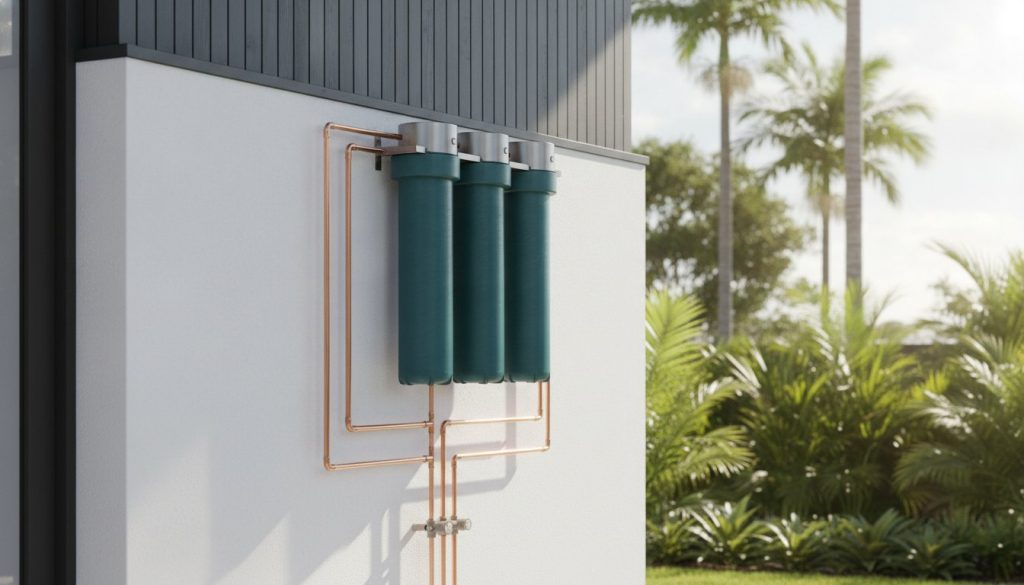
Have you ever wondered why your morning shower smells more like a public swimming pool than a relaxing coastal retreat? Many Sunshine Coast residents find that despite our region’s beautiful surroundings, the water coming out of their taps often carries a heavy scent of chlorine and leaves behind frustrating white scale on glass screens. These issues, along with sediment from older pipes, don’t just affect the taste of your tea; they can also irritate your skin and shorten the lifespan of your hot water system. Installing Whole House Water Filter Systems provides a comprehensive solution by treating every drop before it enters your home’s internal plumbing.
We understand that choosing the right filtration setup can feel overwhelming with so many technical options available. You want the peace of mind that comes with bottled-quality water without the stress of complex maintenance. This guide will help you navigate local water quality facts, mandatory WaterMark certifications, and Queensland’s specific plumbing regulations. By the end of this article, you’ll know exactly how to choose and install a system that protects your family’s health and ensures your household appliances run efficiently for years to come.
Key Takeaways
- Understand why Sunshine Coast water quality requires filtration to remove chlorine residuals and seasonal sediment, even if the supply is naturally soft.
- Learn how Whole House Water Filter Systems act as a “Point of Entry” shield, protecting every tap and appliance in your home from chemical and physical contaminants.
- Discover the critical differences between mains water and rainwater tank filtration, including why UV sterilisation is essential for tank-reliant properties.
- Explore how professional filtration serves as a preventative measure to reduce scale buildup and extend the lifespan of expensive hot water systems.
- Identify the legal requirements for WaterMark certification and licensed plumbing installation to ensure your home insurance and warranties remain protected.
Why Sunshine Coast Homes Need Whole House Water Filter Systems
Living on the Sunshine Coast offers a premium lifestyle, but the water flowing through your taps doesn’t always match that high standard. While our local supply is strictly regulated and safe to drink, many homeowners find the experience of using it less than ideal. Whether it’s the unmistakable scent of chlorine during a hot shower or the gritty sediment that settles in the bottom of a glass, these issues are common across our region. Installing Whole House Water Filter Systems allows you to take control of your home’s water quality, moving beyond basic council compliance to a standard that truly protects your family and your property.
Our coastal environment adds another layer of complexity. High humidity and salt-laden air can be incredibly harsh on external fixtures. We often see standard plastic filter housings become brittle and crack under the intense Queensland sun and salt spray. Choosing high-quality, corrosion-resistant housings is essential for longevity in suburbs like Mooloolaba or Caloundra, where the salt air is most prevalent. This ensures your system remains a reliable part of your home infrastructure for years, rather than a maintenance headache.
The Impact of Chlorine and Hard Water
Unitywater uses chlorine to keep our water microbiologically safe as it travels from treatment plants like Landers Shute to your front gate. While effective for disinfection, chlorine is a harsh chemical that strips natural oils from your skin and hair, often leaving you feeling itchy or dry after bathing. For families with sensitive skin or eczema, this can be a daily source of discomfort.
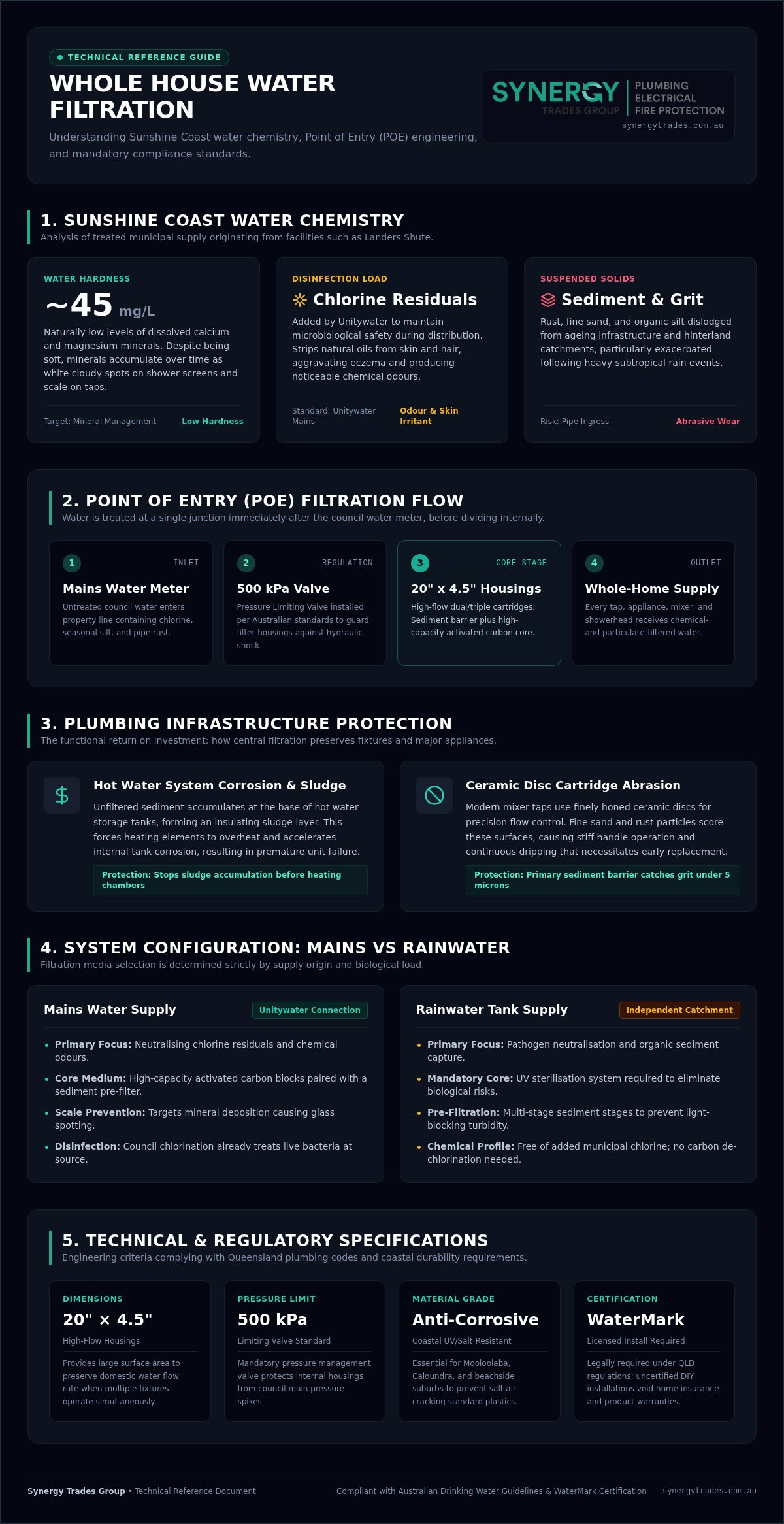
You might also notice white, cloudy spots on your glass shower screens or “furring” around the base of your taps. In Queensland homes, water hardness refers to the concentration of dissolved calcium and magnesium minerals, which, even at the Sunshine Coast’s naturally low levels of approximately 45 mg/L, can still accumulate on surfaces over time. Modern water filtration technologies, specifically high-capacity activated carbon stages, are designed to neutralise these chemical tastes and odours while managing the impact of these minerals on your fixtures.
Sediment and Pipe Integrity
The Sunshine Coast’s infrastructure varies wildly from new developments to established areas with older pipework. As water travels through kilometres of mains, it can pick up rust, fine sand, and organic silt, especially after heavy subtropical rain events in the hinterland catchments. These abrasive particles are the silent enemies of your plumbing. Fine grit is particularly damaging to the delicate ceramic cartridges found in modern mixer taps. Without a primary sediment barrier, these particles can cause leaks or stiff handles, eventually requiring premature tap replacement.
More importantly, filtration plays a vital role in preventing the need for frequent hot water system repairs. By stopping sediment before it enters your storage tank, you prevent the sludge buildup that causes heating elements to overheat and tanks to corrode from the inside out. It’s a simple preventative measure that saves you from the stress and expense of a sudden cold shower.
How Whole House Water Filtration Works: A 2026 Technical Overview
Whole House Water Filter Systems operate on a “Point of Entry” (POE) principle. This means the system is installed where your main water line first enters your property, usually just after the water meter. By filtering at this single source, every tap, showerhead, and appliance receives treated water simultaneously. This setup aligns with the Australian Drinking Water Guidelines by ensuring that even if council water meets standard safety benchmarks, the aesthetic quality and chemical load are significantly improved before they reach your family.
Maintaining high water pressure is a common concern for homeowners when considering filtration. We address this by using high-flow housings, typically 20 inches by 4.5 inches, which provide a large surface area to ensure water moves freely even when multiple showers are running. Under Australian standards, these systems also incorporate a 500 kPa Pressure Limiting Valve. This protects the filter housings from hydraulic shock while keeping your home’s internal pressure at an optimal level for your fixtures.
Stage 1: Sediment Pre-Filtration
The first line of defence in any professional system is a sediment pre-filter. This stage acts as a physical sieve, capturing suspended solids like fine sand, silt, and rust flakes that can break loose from aging mains pipes. Most Australian residential systems use pleated or polyspun cartridges with a micron rating between 5 and 20 microns. A 5-micron filter is incredibly fine; for comparison, a human hair is roughly 70 microns wide. This stage is critical because it prevents gritty particles from clogging the microscopic pores of the more expensive chemical filters that follow.
Stage 2 & 3: Carbon and Chemical Reduction
After physical debris is removed, the water passes through high-capacity activated carbon blocks. These cartridges are engineered to target chemical contaminants that affect health and taste, such as chlorine and Volatile Organic Compounds (VOCs). In some cases, we use specialty media like catalytic carbon to address more stubborn chloramines or heavy metals. Carbon filters function through a process called adsorption, where chemical impurities are physically trapped within the massive internal surface area of the carbon media. This process results in water that tastes and smells as fresh as premium bottled brands from every tap in the house.
If you aren’t sure which filter configuration best suits your household’s peak water usage, you can request a professional assessment from our local team to find the perfect balance between filtration depth and flow rate.
Selecting the Right System: Mains Water vs. Rainwater Tank Solutions
Choosing the right filtration setup depends entirely on where your water starts its journey. On the Sunshine Coast, most suburban homes rely on town mains, while hinterland and rural properties often depend on harvested rainwater. Each source presents unique challenges. This is why a one-size-fits-all approach doesn’t work. The EPA home drinking water filtration guidance highlights that point-of-entry systems must be tailored to the specific contaminants present in the raw water supply to be truly effective.
System capacity is another vital factor we assess. A two-person household has very different flow requirements compared to a large family home with multiple bathrooms. We ensure your system is sized correctly so you don’t experience a drop in pressure when someone starts the dishwasher while you’re in the shower. By matching the filtration technology to your specific water source and usage patterns, you get the most efficient and cost-effective result.
Standard Mains Water Systems
For most residents in suburban blocks, the primary goal is removing chemical additives. A standard dual-stage system usually features a high-flow sediment filter followed by a premium carbon block. This combination effectively neutralises the taste and smell of chlorine while capturing heavy metals that might leach from aging infrastructure. It’s a straightforward, reliable way to ensure Whole House Water Filter Systems deliver bottled-quality water to every tap.
If you’re looking for more advanced protection, you can add specialty stages for fluoride reduction or alkaline re-mineralisation. These additions are popular for families who want to restore a natural mineral balance to their drinking water. When planning your installation, we look for accessible mounting locations like the side of the house or under-house spaces. This makes future cartridge changes simple and ensures the system is protected from the elements.
Rainwater and Tank Water Upgrades
Properties in the hinterland face different risks. Rainwater is naturally soft but can easily become contaminated by bird droppings, leaf tannins, and wind-blown dust. For these homes, Whole House Water Filter Systems must include a mandatory Ultraviolet (UV) sterilisation unit. This stage uses germicidal light to deactivate bacteria and viruses, ensuring your water is biologically safe without using chemicals.
Managing sediment is also more intensive with tank water. We often recommend multi-stage sediment filtration to handle the heavier load from roof runoff. To ensure your filters don’t clog prematurely, it’s vital to maintain your catchment area. Regular Sunshine Coast Gutter Repairs and cleaning will significantly improve the quality of your source water, allowing your filtration system to work more efficiently. We also evaluate your pump’s flow rate to ensure the UV system has enough contact time to properly disinfect the water during peak usage.
The Installation Process: What to Expect and How to Prepare
In Queensland, installing Whole House Water Filter Systems is considered regulated plumbing work. This means it legally requires a licensed professional holding a current QBCC licence. Attempting a DIY installation on town mains is unlawful and can void your home insurance or manufacturer warranties. Our team follows a methodical process to ensure your system meets all Australian standards while providing the best performance for your specific property layout.
The first step involves identifying the main water line and selecting an optimal mounting location. This spot must be accessible for future maintenance but also shielded from the intense Sunshine Coast sun and salt spray. Second, we install a three-valve bypass manifold. This loop is essential; it allows you to divert water around the filters during cartridge changes, ensuring your house never loses water supply during servicing. Finally, we conduct rigorous pressure testing to confirm every fitting is secure before flushing the system to clear any initial carbon fines.
Preparation for Homeowners
You can help the process run smoothly by clearing a path to your water meter and ensuring the area around your external pipework is free of debris or overgrown gardens. It is also wise to plan for your first cartridge change. While most filters last six to twelve months, a new installation can sometimes capture a sudden surge of sediment from the initial pipework connection. We recommend checking your gauges after the first month to establish a baseline for your specific usage.
A professional setup significantly benefits your hot water installation by preventing grit from entering the heating tank. This proactive step reduces the risk of internal corrosion and keeps your system running at peak efficiency for years to come.
Compliance and Safety Standards
Safety and legality are our priorities. We only install WaterMark™ certified products. In Australia, this certification is a legal mandate for any equipment connected to your mains water. Using non-certified housings is a major risk that can lead to burst pipes and significant property damage. Furthermore, we ensure your system includes a 500 kPa Pressure Limiting Valve to protect against hydraulic shock.
We also ensure your system includes the correct backflow prevention devices. Under AS/NZS 3500.1, these valves protect the public water supply from potential contamination. For many Sunshine Coast properties, we handle the mandatory council reporting and Form 9 lodgements required for testable devices, giving you complete peace of mind that your home is fully compliant.
Ready to upgrade your home’s water quality? You can book a licensed plumber today to discuss the best mounting location for your new filtration system.
Protecting Your Plumbing: The ROI of Whole-Home Filtration
Investing in Whole House Water Filter Systems is a strategic move for any homeowner looking to safeguard their property’s long-term value. While the health benefits of cleaner drinking water are clear, the return on investment (ROI) often comes from the protection of your internal infrastructure. Appliances like dishwashers, washing machines, and high-end coffee makers rely on delicate internal valves and heating elements. When these components are constantly exposed to chlorine and abrasive sediment, they wear out much faster than intended. By removing these elements at the source, you ensure your expensive appliances reach their full service life.
Filtered water also plays a major role in maintaining the aesthetic appeal of your home. Modern, high-end bathroom tapware, especially in matte black or brushed brass finishes, is highly susceptible to damage from chemical residues and mineral spotting. Beyond the surface, preventing the accumulation of grit helps in reducing the frequency of blocked drains. Over time, fine sediment can settle in low-flow areas of your drainage system, creating a foundation for other debris to latch onto. A whole-home system stops this process before it begins, protecting your family’s largest investment from the inside out.
Hot Water System Longevity
Your hot water unit is often the most expensive plumbing asset in your home. In traditional storage tanks, sediment that bypasses basic screens settles at the bottom. This leads to a phenomenon known as “kettling,” where the sediment layer insulates the water from the heating element, causing it to overheat and eventually crack. For those with instantaneous gas units, fine particles can clog the narrow passages of the heat exchanger, leading to inconsistent temperatures and eventual failure.
By installing a primary filtration barrier, you significantly lower the risk of internal corrosion and tank bursts. This proactive approach reduces the need for emergency water leak detection services, which are often required when a neglected unit finally gives way. It’s a simple case of prevention being far more cost-effective than a reactive cure.
The Synergy Trades Advantage
At Synergy Trades Group, we bring over 70 years of combined industry experience to every installation. Being a family-owned local business, we understand the specific challenges Sunshine Coast water presents to our neighbours. Our unique advantage lies in our dual expertise; because we handle both plumbing and electrical work, we can manage complex UV sterilisation installs and pressure pump integrations without the need for multiple contractors. This holistic perspective ensures a more reliable, efficient, and tidy result for your home.
We take immense pride in our workmanship and our commitment to the local community. We aren’t just installing filters; we’re providing peace of mind and protecting the longevity of your home’s most vital systems. If you’re ready to see the difference that professional filtration can make, organise a water quality consultation with our local experts today and take the first step towards a healthier, more efficient home.
Invest in Your Home’s Long-Term Health
Choosing to install Whole House Water Filter Systems is a significant step toward protecting both your family’s wellbeing and your property’s most valuable infrastructure. By removing harsh chemicals and abrasive sediment at the point of entry, you ensure every shower is gentle on your skin and every appliance is shielded from premature failure. This proactive approach eliminates the frustration of scale buildup and extends the life of your hot water system, providing a clear return on investment through reduced maintenance costs.
As a family-owned and operated local business with 70+ years of combined industry experience, we understand the specific water profiles of the Sunshine Coast. Our team of licensed plumbing and electrical experts ensures every installation is compliant, tidy, and tailored to your household’s flow requirements. We take pride in our traditional service values and our commitment to providing honest, dependable advice to our neighbours.
Ready to enjoy bottled-quality water from every tap in your home? Get a Professional Water Filtration Quote from Synergy Trades Group today. We look forward to helping you secure your home’s water quality for the future.
Frequently Asked Questions
Do I really need a whole house water filter on the Sunshine Coast?
While Sunshine Coast council water meets Australian health standards, it often contains chlorine levels that affect taste and can irritate sensitive skin. Many local residents choose Whole House Water Filter Systems to remove these chemicals and seasonal sediment before they enter the home. This provides a consistent quality of water for drinking, bathing, and laundry, while acting as a preventative measure to protect your internal pipework from chemical degradation and grit buildup.
Will a whole house filter reduce my water pressure?
A correctly sized system shouldn’t cause a noticeable drop in your household water pressure. We typically install high-flow 20-inch housings that are specifically designed to handle the peak demand of a modern family home. By selecting the right micron rating and ensuring the system is professionally installed with a pressure limiting valve, you’ll enjoy clean water without compromising the performance of your showers, washing machines, or garden taps.
How often do the filter cartridges need to be replaced?
Most households find that their filter cartridges need replacing every six to twelve months. This timeframe depends on your total water consumption and the amount of sediment present in your local mains. If you notice a slight drop in pressure or a change in taste, it’s usually a sign that the cartridges have reached their capacity. Regular maintenance ensures your system continues to provide optimal protection for your family and your expensive household appliances.
Can a whole house water filter remove fluoride?
Standard sediment and carbon filters are not designed to remove fluoride from your water supply. If fluoride reduction is a priority for your family, we can incorporate specialty activated alumina or bone char cartridges into your system configuration. These specific stages are designed to target fluoride ions effectively. It’s important to discuss your specific goals with us during your consultation so we can design a multi-stage system that meets your health and taste preferences.
Is it better to have an under-sink filter or a whole house system?
An under-sink filter only treats water at a single tap, whereas Whole House Water Filter Systems protect every outlet in your property. While under-sink units are great for drinking, they don’t protect your hot water system, washing machine, or your skin during a shower. For comprehensive protection of your home’s infrastructure and your family’s health, a whole-home approach is generally the superior long-term investment for Sunshine Coast properties and hinterland homes.
How much space is required for a whole house filtration unit?
Most residential units are compact and designed to be wall-mounted near your water meter or on the side of the house. A typical twin or triple housing setup requires a vertical space of about 700mm in height and 600mm in width. We always look for a location that allows enough clearance at the bottom for easy cartridge changes while keeping the unit protected from direct sunlight and the harsh coastal salt air.
Does a whole house filter require an electrical connection?
Standard sediment and carbon filtration systems are purely mechanical and don’t require any electricity to function. However, if you are on a rainwater tank and require a UV sterilisation unit for biological safety, a standard 10-amp outdoor power point will be necessary. Because our team includes licensed electrical experts, we can easily manage the installation of a safe, weather-protected power outlet if your specific filtration setup requires an ultraviolet light stage.
Will a whole house filter stop the white scale on my shower screen?
A whole-house system will significantly reduce the appearance of white scale by removing the sediment and chlorine that often bond with minerals on glass surfaces. These systems are not water softeners, but because Sunshine Coast water is naturally soft, the “scale” residents see is often a mix of light mineral content and chemical residues. Professional filtration makes cleaning much easier and prevents the heavy, stubborn buildup that can permanently etch your glass screens.