Imagine it’s a humid Tuesday night in Mooloolaba when your power suddenly cuts out, leaving the kids in the dark and the fridge warming up. You check the switchboard, flip the toggle, but it trips again ten minutes later. For many homeowners, the need for professional safety switch installation sunshine coast families can trust becomes clear only when a persistent fault occurs. It’s frustrating when you’re unsure if your electrical system is actually protecting your home or just struggling against our harsh, coastal salt-air corrosion.
We know that staying on top of electrical standards feels like a chore, especially with the Electrical Safety Regulation 2026 now active in Queensland. This guide will help you understand why modern RCD protection is essential and how to ensure your property meets these updated safety benchmarks. We’ll walk through the differences between safety switches and circuit breakers, explain how to stop nuisance tripping, and show you why a modern upgrade is a sensible long-term investment. You’ll find the answers you need to keep your home safe and compliant without having to navigate confusing industry jargon.
Key Takeaways
- Understand the critical difference between protecting your home’s wiring with circuit breakers and protecting your family with life-saving RCDs.
- Learn why the Queensland Electrical Safety Regulation 2026 now requires safety switches on all final sub-circuits to meet modern compliance standards.
- Discover why professional safety switch installation sunshine coast properties need must account for the unique effects of salt-air corrosion on electrical components.
- Master a simple step-by-step troubleshooting guide and the mandatory six-monthly “Push Button” test to ensure your protection never fails.
- Gain peace of mind by choosing a fixed-fee service from local experts who prioritise your home’s safety over complex technical jargon.
Why Safety Switch Installation is Non-Negotiable for Sunshine Coast Homes
Safety switches are the unsung heroes of your home’s electrical system. Unlike standard circuit breakers, which are designed to protect your house’s wiring from melting or catching fire during an overload, a safety switch is there specifically to save lives. Technically known as a Residual-current device (RCD), this component monitors the balance of electricity flowing through a circuit. If it detects even a tiny leak to earth, it cuts the power in as little as 30 milliseconds. This is often the difference between a minor tingle and a fatal electric shock.
Many older properties across our region still rely on outdated ceramic fuses. While these were standard decades ago, they offer zero protection against electrocution. If you’re living in an older home, prioritising a professional safety switch installation sunshine coast service is the most effective way to modernise your switchboard and protect your family. If your current switch trips frequently, don’t just flip it back on. This “nuisance tripping” is usually a warning sign of a faulty appliance or a breakdown in your home’s insulation that needs professional attention.
The Coastal Factor: Salt Air and Electrical Corrosion
Living near the ocean brings beautiful views, but it also brings salt-laden air that is incredibly aggressive toward metal. In suburbs like Mooloolaba and Caloundra, we often see “verdigris,” which is a green, crusty corrosion that forms on copper terminals and internal switchboard components. This salt-air degradation can cause safety switches to become “sticky” or fail to trip when needed. Because of this, coastal homeowners should test their units every few months to ensure the mechanical parts haven’t seized up. Keeping your switchboard clean and sealed is a small step that prevents big safety risks.
Storm Season Readiness: Queensland’s Unique Challenges
Our local storm season is another reason why modern protection is vital. Intense Queensland summer storms bring heavy rain and high humidity, which often leads to moisture ingress in outdoor power points or garden lighting. A modern safety switch will detect this moisture-induced fault immediately, shutting down the circuit before it becomes a hazard. While a surge protector handles lightning spikes, a safety switch is your primary defence against the electrical faults that follow a heavy downpour. Ensuring you have a high-quality safety switch installation sunshine coast wide is essential before the first big storm hits.
Queensland’s 2026 Electrical Safety Standards: What Homeowners Need to Know
The legal landscape for electrical safety in Queensland changed on 1 September 2026 with the commencement of the Electrical Safety Regulation 2026. While the primary Electrical Safety Act 2002 remains the foundation, this updated regulation clarifies the strict obligations for residential properties. The most significant takeaway for locals is that safety switches are no longer just for power points. Modern standards now require RCD protection on all final sub-circuits. This includes your lights, air conditioning units, and even the oven circuit. When you book a professional safety switch installation sunshine coast electricians must ensure every circuit in your home meets these rigorous criteria to be fully compliant.
Many homeowners believe they are protected by “grandfather clauses” because their home was built decades ago. It’s a common misconception. These exemptions usually vanish the moment you undertake a renovation, add a new power point, or prepare the property for sale. In these scenarios, the entire switchboard often needs to be brought up to current 2026 standards. Once the work is finished, your electrician is legally required to provide an Electrical Safety Certificate. This document is your proof that the work is licensed and compliant, which is vital for insurance purposes and future property valuations.
Rental Property Compliance on the Sunshine Coast
Landlords now face tighter scrutiny regarding electrical safety. The 2026 regulatory framework reinforces the mandatory requirement for functional safety switches on all rental circuits. There is a growing industry shift toward mandatory annual electrical inspections to protect both tenants and property owners from avoidable accidents. We help many local property managers organise safety audits to ensure their portfolios remain compliant and protected against potential litigation. A small investment in regular testing prevents major legal headaches down the road.
The 2026 Switchboard Upgrade: Beyond the Minimum
Adding a single switch to an old board with ceramic fuses is rarely enough to meet modern demands. We typically recommend moving to RCBOs (Residual Current Breaker with Overcurrent protection). These clever devices combine the functions of a safety switch and a circuit breaker into one compact unit. This setup is particularly important if you’re planning to install an EV charger or high-load appliances. Upgrading now ensures your home is future-proofed for the next decade of technological changes while providing the highest level of protection available under the latest safety switch installation sunshine coast standards.
Safety Switches vs. Circuit Breakers: A Comparison for Homeowners
Walking up to your switchboard can be confusing if you don’t know what you’re looking at. Most modern boards contain a row of similar-looking switches, but they serve two very different masters. Circuit breakers are designed to protect your home’s wiring and appliances. They trip when a circuit is overloaded, preventing the wires from overheating and potentially starting a fire. However, a circuit breaker will not stop you from receiving a fatal electric shock. It only cares about the volume of current, not where that current is going.
This is where a safety switch differs. Its sole purpose is to protect people. While circuit breakers monitor for “too much” power, safety switches monitor for “lost” power. If electricity begins flowing through a person instead of the wires, the safety switch detects the leak and cuts the power instantly. If your home still uses old-school ceramic fuses, you have neither of these modern protections. Upgrading to a combined RCD and circuit breaker system is the gold standard for any safety switch installation sunshine coast residents undertake in 2026.
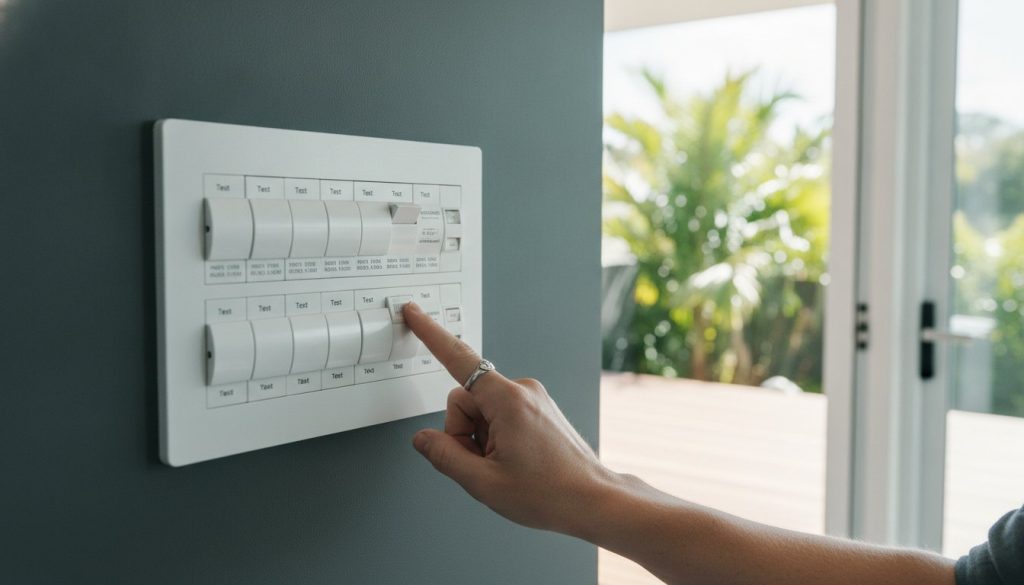
The easiest way to tell the difference is the “Test” or “T” button. Only safety switches have this feature. If a switch on your board doesn’t have a button, it’s likely a standard circuit breaker or a main switch, meaning it offers no protection against electrocution. Identifying these gaps is the first step toward a safer home.
How an RCD Actually Works
A safety switch works on the principle of balance. It constantly measures the electricity going out into a circuit and the electricity coming back. Under normal conditions, these two numbers are identical. If the device detects an imbalance, even as small as 30 milliamperes, it assumes the missing electricity is leaking to earth, perhaps through a person touching a faulty toaster. It then reacts at the speed of light, shutting down the circuit in about 0.03 seconds. That tiny millisecond window is the difference between a small fright and a tragedy.
Common Misconceptions About Electrical Protection
Many homeowners fall into the trap of believing they are fully covered when they aren’t. Here are three common myths we encounter:
- “I have a new house, so I’m 100% protected.” Even homes built ten years ago might only have safety switches on power point circuits, leaving lights and appliances unprotected.
- “Safety switches never wear out.” Like any mechanical device, they can fail. This is especially true on the Coast where salt air can seize the internal mechanisms.
- “One safety switch is enough.” Relying on a single switch for the whole house is risky. If it fails, you have no backup. Modern 2026 standards require multiple switches to ensure “nuisance” faults don’t leave your entire home in the dark.
Ensuring your protection is up to date is a simple way to gain peace of mind. If you haven’t had your board checked recently, a professional safety switch installation sunshine coast audit can confirm if your family is truly protected.

How to Test and Troubleshoot Your Safety Switch
Regularly testing your safety switch is the only way to ensure the internal mechanical parts haven’t seized up. We recommend performing a “Push Button” test every six months. Simply locate the switch on your board with the “T” or “Test” button and press it. The switch should instantly flip to the “OFF” position and cut power to that circuit. If it doesn’t trip, or if the lever feels stiff or “crunchy” when you try to reset it, the device is faulty. This is a common issue in our coastal environment where salt air can corrode sensitive components. In these cases, booking a safety switch installation sunshine coast service is the only safe way to restore protection.
If your switch has tripped and refuses to stay in the “ON” position, you’re likely dealing with a “hard fault” in an appliance or the wiring itself. Don’t try to force the switch to stay up. This is a safety feature doing its job. Instead, follow a logical process of elimination to find the source of the problem before calling for professional help.
Step-by-Step Fault Finding Guide
To find the culprit, start by unplugging every single appliance on the affected circuit. It’s vital to physically pull the plugs out of the sockets rather than just flicking the wall switch. Once everything is disconnected, try to reset the safety switch at the board. If it stays on, you can begin plugging your items back in one by one. The moment the switch trips again, you’ve found your faulty appliance.
Keep in mind that some faults are intermittent. Devices like kettles, fridges, or dishwashers might only cause a trip when they reach a certain part of their cycle, such as when a heating element engages. If the switch trips randomly throughout the day, these high-draw appliances are usually the first place to look.
Why Your Safety Switch Trips When It Rains
On the Sunshine Coast, we often see safety switches trip during heavy downpours. This usually happens because moisture has found its way into outdoor power points, garden lighting, or even the motor of a pool pump. Sometimes, the issue isn’t electrical at all. Blocked gutters can cause rainwater to overflow into wall cavities, soaking the cables behind your plasterboard. Because Paul and Lynda have over 70 years of experience across both electrical and plumbing trades, we can identify if your electrical fault is actually being caused by a hidden plumbing leak. If you’re tired of “nuisance tripping” every time a storm rolls through, you can book a comprehensive safety inspection to find the root cause and fix it for good.
Professional Safety Switch Installation with Synergy Trades Group
Choosing a contractor for your safety switch installation sunshine coast project is about more than just finding a technician. It’s about finding a partner who understands the local environment and the families who live here. Synergy Trades Group is a family-owned business run by Paul and Lynda, who bring over 70 years of combined industry experience to every home. We don’t believe in high-pressure sales tactics. Instead, we offer a fixed-fee approach. This means you’ll know exactly what the investment will be before we even open our toolkits, ensuring there are no nasty surprises on your final invoice.
What we call the “Synergy Advantage” is our ability to look at your property as a complete system. Because we specialise in both electrical and plumbing compliance, we see the bigger picture. We don’t just look at the switchboard; we consider how your home’s various systems interact to ensure your property is truly safe. This grounded and sincere approach prioritises your peace of mind over a quick sale, reflecting our long-standing commitment to the Sunshine Coast community.
What to Expect During Your Installation
We aim to make the upgrade process as low-friction as possible. Every professional safety switch installation sunshine coast residents book with us begins with a thorough audit of the existing switchboard and the home’s earthing system. This is crucial because a safety switch is only as effective as the earth connection it relies on. While we do need to turn off the power to work safely, we plan our tasks to ensure minimal downtime for your household. Once the new components are in place, we perform rigorous final testing and provide you with an Electrical Safety Certificate. This document confirms your home meets the latest 2026 standards and is essential for your insurance records.
Beyond Safety Switches: A Holistic Approach to Maintenance
Our expertise doesn’t stop at the switchboard. We take a holistic approach to property maintenance by integrating services like smoke alarm installation and testing with plumbing compliance checks. Having one trusted team manage your “wet and dry” trades saves you the hassle of coordinating multiple contractors. It also ensures that potential issues, like a plumbing leak near an electrical circuit, are caught and resolved before they cause a hazard. If you want to ensure your home is fully protected, you can organise your electrical safety audit with Synergy Trades today.
Securing Your Home for the Future
Meeting the Electrical Safety Regulation 2026 is about more than just ticking a compliance box; it’s about the genuine protection of your family and property. The shift toward mandatory RCD protection on all final sub-circuits represents the highest standard of safety currently available. Understanding the distinction between protecting your wires and protecting your loved ones is the first step toward a safer household, especially when dealing with the corrosive effects of our coastal environment.
A professional safety switch installation sunshine coast audit is a sensible investment in your property’s longevity. Paul and Lynda bring over 70 years of combined industry experience to every job, ensuring your home is handled by fully licensed and insured Queensland tradespeople who truly care about local families. Don’t leave your electrical safety to chance. You can Book Your Sunshine Coast Safety Switch Audit with our family-owned team today. We’re ready to help you create a safer, compliant home that gives you total peace of mind.
Frequently Asked Questions
How many safety switches do I need in my Sunshine Coast home?
Under 2026 Queensland standards, you need RCD protection on all final sub-circuits. This isn’t a fixed number but depends entirely on your home’s unique electrical layout. Usually, this means separate switches for power, lights, air conditioning, and oven circuits. Having multiple switches ensures that a fault in one area doesn’t plunge your entire house into darkness. It’s a more reliable way to manage your home’s electrical safety than relying on a single unit.
Why does my safety switch trip at the same time every day?
This usually points to a timer-controlled appliance or a specific routine. Common culprits include pool pumps, fridges reaching a defrost cycle, or even off-peak hot water systems. If it happens when the streetlights come on, it might be ripple control tones from the grid. A professional safety switch installation sunshine coast expert can install a filter or identify the specific faulty appliance causing the pattern to ensure your power stays on consistently.
Can I install a safety switch myself to save money?
No, it’s illegal and extremely dangerous to perform your own electrical work in Queensland. All electrical installations must be completed by a licensed electrician who can provide an Electrical Safety Certificate. DIY electrical work voids your home insurance and carries heavy fines. It’s always better to trust a local family-run business that understands the specific compliance requirements of the 2026 regulations. Your family’s safety isn’t worth the risk of a shortcut.
How much does it cost to replace an old switchboard on the Sunshine Coast?
The cost varies based on the size of your home and the condition of the existing wiring. Factors like the number of circuits, the presence of asbestos backing boards, or the need for a new earthing system all influence the final investment. Because we value transparency, we provide fixed-fee quotes so you’ll know the exact amount before we start. This approach ensures there are no surprises on your final invoice when the work is finished.
What is the difference between an RCD and an RCBO?
An RCD is a standard safety switch that only protects people from electric shocks. An RCBO (Residual Current Breaker with Overcurrent) is a more advanced device that combines the features of a safety switch and a circuit breaker. It protects both people from shocks and your home’s wiring from overloads. Most modern safety switch installation sunshine coast projects now use RCBOs for superior, all-in-one protection. They are the most efficient way to modernise an old switchboard.
Does a safety switch protect me from a lightning strike?
Not directly. A safety switch is designed to detect current leaking to earth and prevent electrocution. It doesn’t protect your electronics from the massive voltage spikes caused by lightning. To guard against storm-related damage, you should have a dedicated surge protection device installed alongside your safety switches. This combination provides the best defence for your family and your expensive appliances during the intense Queensland storm season when lightning strikes are most frequent.
How often should I realistically test my safety switches?
You should realistically test your safety switches every six months using the “Push Button” method. This mechanical check ensures the internal components haven’t seized up due to salt-air corrosion or dust. It’s a simple task that takes seconds but provides vital confirmation that the device will actually trip in an emergency. If the button doesn’t snap the switch off immediately, call a professional for a replacement to ensure your home remains protected.
My house was built in the 90s; do I already have safety switches?
Homes built in the 1990s were often only fitted with safety switches on power point circuits. This means your lights, stove, and air conditioning are likely unprotected. Current 2026 standards require much broader coverage to ensure every part of your home is safe. If you haven’t upgraded your board recently, it’s highly probable that your electrical system is outdated and doesn’t meet the latest Queensland safety requirements for full property protection.