What if the biggest electrical compliance risk isn’t a faulty appliance, but a hazard that’s spotted and never followed up? Queensland workplaces know regular checks matter, but it can be hard to tell which issues need prompt attention, how electrical safety duties fit with general WHS responsibilities, and whether records are complete. Electrical Safety Building Compliance Workplace Health & Safety is easier to manage when it’s treated as an ongoing, documented process rather than a one-off inspection.
This guide explains how to build that process for your workplace. You’ll learn practical ways to identify and manage electrical risks, understand how Queensland’s electrical safety requirements relate to broader workplace duties, and keep useful records of inspections, testing and maintenance. It also covers when to involve a qualified electrical professional and what to clarify about the work and documentation provided.
We’ll look at the role of RCD testing, AS/NZS 3760:2022 and Queensland’s Electrical Safety Regulation 2026, which is now in effect. Whether you manage a workplace on the Sunshine Coast or elsewhere in Queensland, a clear routine can make electrical safety checks easier to organise, review and follow up.
Key Takeaways
- See how electrical safety checks fit within broader building maintenance, and why one doesn’t replace the other.
- Understand why Queensland workplace responsibilities may depend on the work being done and who controls the equipment, and which legislation to check.
- Use visible warning signs, such as damaged leads or faulty safety switches, to guide prompt controls and follow-up.
- Put Electrical Safety Building Compliance Workplace Health & Safety into practice with a repeatable process for assigning actions and recording outcomes.
- Learn when Sunshine Coast businesses may benefit from professional RCD testing, safety switch work or exit lighting support, and what a service visit can and can’t confirm.
What electrical safety and building compliance mean for Queensland workplaces
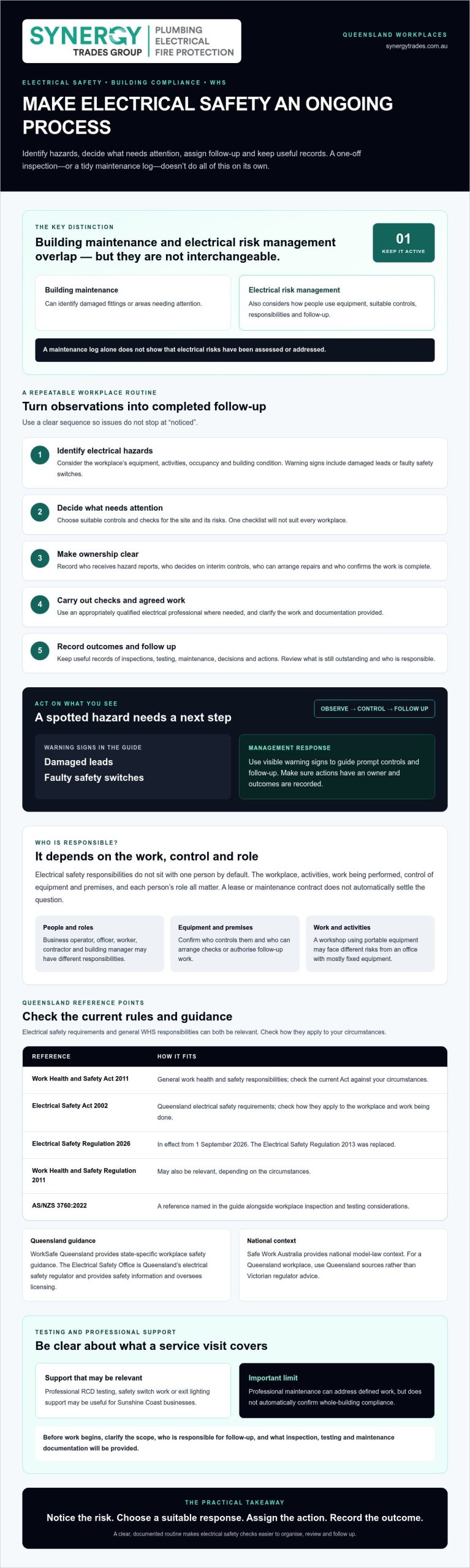
Electrical safety compliance means identifying electrical hazards, putting suitable controls in place and keeping evidence of checks, decisions and follow-up work. The right checks depend on the workplace and its risks, so one checklist won’t suit every site.
Electrical safety and building maintenance overlap, but they’re not interchangeable. A maintenance review might identify damaged fittings or areas needing attention. Electrical risk management also considers how people use equipment and what controls are needed to reduce the chance of harm. A tidy maintenance log alone doesn’t show that electrical risks have been assessed or addressed. For a practical foundation on how a Residual-current device (RCD) works, see this technical overview.
A sound approach to Electrical Safety Building Compliance Workplace Health & Safety links site observations with clear responsibilities, appropriate action and records. This helps managers see what’s been identified, what still needs attention and who is responsible for following it up.
Which Queensland workplaces and buildings should review electrical risks?
Offices, shops, workshops and managed commercial buildings should consider electrical risks in the context of their own operations. Occupancy, equipment, site activities and building condition can all affect which hazards are present and what checks are appropriate. A workshop using portable equipment, for example, may face different risks from an office with mostly fixed equipment.
Start by confirming who controls the premises, equipment and maintenance decisions. Responsibility may be shared between a business, building owner, tenant or maintenance provider. Clarify who can arrange checks and authorise follow-up work.
How do WHS duties relate to electrical safety obligations?
General work health and safety responsibilities concern managing risks to people at work. Queensland electrical safety requirements address electrical hazards and work involving electricity. Both may be relevant, but the duties that apply depend on the workplace, activities and control of equipment. Check the Work Health and Safety Act 2011, the Electrical Safety Act 2002 and the current Electrical Safety Regulation 2026 against your circumstances.
Safe Work Australia provides national model-law context, while WorkSafe Queensland offers state-specific workplace safety guidance. Queensland’s Electrical Safety Office (ESO), within the Office of Industrial Relations, is the state’s electrical safety regulator and provides electrical safety information and oversees licensing. Don’t rely on Victorian regulator advice for a Queensland workplace. For local context, Synergy Trades Group outlines its electrical safety and maintenance services on the Sunshine Coast. Professional maintenance can address defined work, but doesn’t automatically confirm whole-building compliance.
Queensland electrical safety duties: what workplace managers need to understand
Electrical safety responsibilities don’t sit with one person by default. The requirements that apply depend on the workplace, the work being performed, who controls the equipment and premises, and each person’s role. A business operator, officer, worker, contractor and building manager may all have different responsibilities. Don’t assume a lease or maintenance contract settles the question. Clarify who can report hazards, arrange repairs and confirm that work is complete.
Queensland managers should check current legislation and regulator guidance rather than relying on a generic checklist. Key references include the Work Health and Safety Act 2011 and the Electrical Safety Act 2002. The Work Health and Safety Regulation 2011 may also be relevant, depending on the circumstances. The Electrical Safety Regulation 2013 was replaced by the Electrical Safety Regulation 2026, which took effect on 1 September 2026. Check the current versions and how they apply to your workplace before making decisions.
Who should take responsibility for follow-up?
Make responsibilities clear in writing. Note who receives reports about damaged equipment, who decides on interim controls, who arranges qualified electrical work and who checks that the action is complete. Where a tenant, building owner and contractor share control, confirm the handover rather than assuming someone else will act. Keep the record with the relevant hazard and maintenance information.
When should a manager seek advice?
Refer uncertain legal interpretations to current Queensland regulator guidance or a suitably qualified adviser. WorkSafe Queensland provides workplace safety guidance, while the Electrical Safety Office (ESO), within Queensland’s Office of Industrial Relations, regulates electrical safety, licensing and compliance. Safe Work Australia provides national model-law context; it isn’t a substitute for checking Queensland requirements.
Act promptly on exposed wiring, damaged electrical equipment, recurring faults or other suspected electrical hazards. Keep people away from the hazard and arrange appropriate assessment or repair. Don’t ask workers to investigate or repair electrical faults unless they’re appropriately qualified and authorised. Record what was found, any interim control, who was notified and how the issue was resolved.
This article offers practical information, not legal advice or a determination that a workplace complies. For related service context, see commercial electrical safety guidance. If you’ve identified electrical work that needs attention, you can request help with electrical safety work through Synergy Trades Group.
How to identify electrical hazards and choose the right safety checks
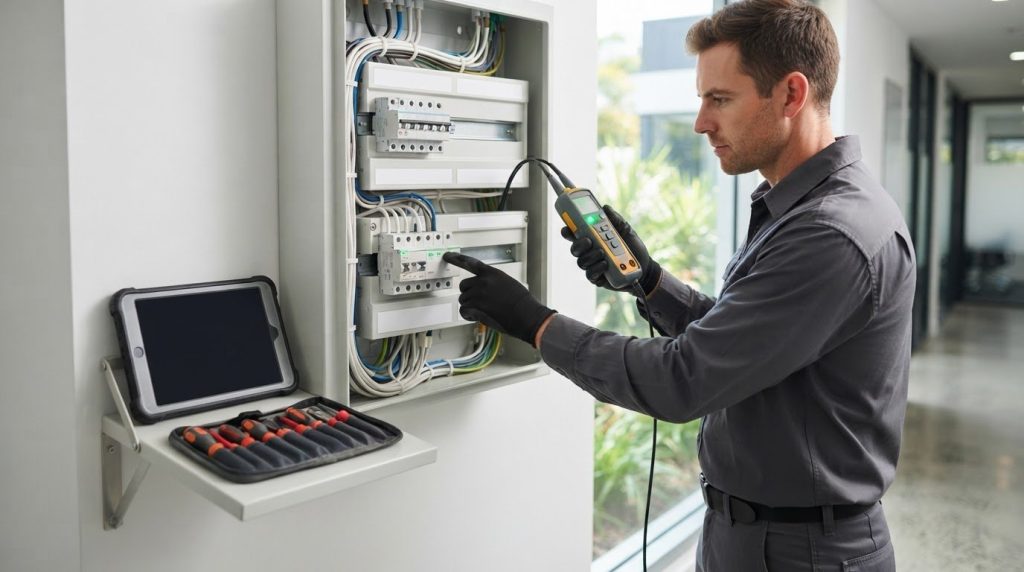
Start with what people can see and report. A visual check can flag damage or unsafe conditions, but it doesn’t replace electrical testing, repairs or assessment by a suitably qualified professional. If equipment appears unsafe, stop using it, prevent others from using it where practical and report it through your site process. Don’t open equipment or attempt repairs unless appropriately qualified and authorised.
Which electrical warning signs should prompt action?
Look for damaged cords, exposed components, scorch marks, unusual heat, repeated tripping, overloaded outlets and poorly maintained electrical areas. A faulty safety switch also needs follow-up. Record the location and observed issue, apply an appropriate interim control and assign someone to arrange the next step.
| Visible hazard | Immediate control | Responsible person | Follow-up record |
|---|---|---|---|
| Damaged lead or exposed component | Stop using the equipment and prevent access where practical. | Worker reports it; site contact arranges assessment. | Equipment ID or location, report date and action taken. |
| Scorch marks or unusual heat | Keep clear and report promptly; don’t investigate internally. | Site manager coordinates suitable assessment. | Location, observations, interim controls and outcome. |
| Overloaded outlets | Stop adding loads and report the setup for review. | Supervisor or person managing the area. | Equipment involved, location and assigned action. |
| Repeated tripping or faulty safety switch | Report the fault and don’t rely on a suspect device for protection. | Manager arranges assessment by a qualified electrical professional. | Fault history, date reported and repair or test evidence. |
| Poorly maintained electrical area | Keep access clear and report visible damage or unsafe conditions. | Building or facilities contact, as agreed on site. | Area, hazard, control and completion confirmation. |
When are testing, tagging and safety switch checks relevant?
Visual checks help identify obvious problems. Testing and tagging involve inspection and testing of relevant electrical equipment, while fault-finding, repairs and safety switch testing require appropriate expertise. The equipment type, how often and where it’s used, the environment and the risk should inform the checking plan. Don’t apply one testing interval to every workplace; specialised contractors such as Banner Power routinely tailor testing and maintenance programs to the specific operational demands of high-use commercial and industrial settings.
AS/NZS 3760:2022 covers in-service inspection and testing of electrical equipment and RCDs. AS/NZS 3000 relates to electrical installations. Confirm the current edition and its applicability to the equipment or installation, alongside Queensland guidance. Keep test results and repair evidence with your hazard records. For service-specific information, see appliance testing and tagging. A useful Electrical Safety Building Compliance Workplace Health & Safety record connects each finding to a control, an owner and documented follow-up.
Build a repeatable process for Electrical Safety Building Compliance Workplace Health & Safety
A simple routine makes it easier to move from spotting a hazard to confirming it’s been addressed. Adapt these steps to your workplace, equipment and risk profile:
- Assign responsibility. Confirm who receives reports, organises checks, authorises work and verifies completion. Include relevant workers, contractors, property managers and electrical service providers.
- Inspect. Carry out suitable visual checks and note hazards or changes in the condition or use of equipment and electrical areas.
- Assess risk. Consider who could be harmed, how likely exposure is and whether immediate controls are needed. Seek qualified advice where the issue requires technical assessment.
- Act. Record the interim control, action owner and next step. Arrange work with an appropriately qualified electrical professional when required.
- Review records. Confirm actions are complete, file supporting evidence and look for recurring issues that may need further attention.
Keep the process practical. Workers need to know how to report a fault, while contractors and service providers need a clear contact and access to relevant site information. Property managers and business operators should agree who can approve repairs and who will check the outcome. This helps prevent a reported issue from being lost between handovers.
What should an electrical safety register include?
Use a register that identifies the equipment or area and gives each issue a clear history. Record the location, hazard, date identified, interim controls, assigned action, responsible contact and completion evidence. Add inspection or test information where relevant, along with repair records and photographs that help show the condition before and after work. Store documents where the people responsible for follow-up can find them.
Retention periods can depend on applicable legal, operational and insurer requirements. Confirm what applies to your workplace rather than assuming one period suits every record. A clear audit trail supports practical decisions, but doesn’t by itself establish that every part of a building complies.
How should businesses manage faults, repairs and recurring issues?
Where it’s safe and appropriate, isolate suspect equipment or restrict access to the affected area while arranging assessment. Record who authorised the work and how the workplace confirmed the hazard was addressed, such as by reviewing service documentation or checking that the item was removed from use. If a fault recurs, link the new report to previous records so it can be reviewed as a pattern.
Building safety systems also need organised follow-up. For example, record checks and remedial work relating to emergency exit lighting alongside other relevant maintenance records. If you need help with defined electrical safety work, request electrical safety support. A service visit can address the agreed work, while your workplace process continues to manage responsibilities and records across the site.
Arrange practical electrical safety support on the Sunshine Coast
Once a workplace has identified a fault or testing need, a qualified electrical professional can help with the specific work required. This may include RCD testing and certification, safety switch installation, smoke alarm installation and testing, or emergency evacuation and exit lighting. The right scope depends on the site and issue, so explain what you’ve observed and ask what work and documentation are included.
Synergy Trades Group provides electrical safety and maintenance services for properties on the Sunshine Coast. A service visit can address agreed work, but it doesn’t automatically certify that an entire building or workplace complies with every relevant requirement. Keep managing site-wide risks and records through your own workplace process, and confirm the scope of any testing or documentation before work begins.
What electrical safety work can a local trade provider assist with?
Support may be useful if a safety switch needs installation, an RCD requires testing, or a concern has been identified with smoke alarms or exit lighting. You can review the available electrical safety services and describe the work your site needs. If you’re requesting RCD testing and certification, clarify which devices will be tested and what records will be provided for your compliance file.
Be specific about the issue. A recurring trip, a suspected faulty safety switch and a planned testing visit each call for different information. Clear details help establish whether the requested service matches the work required, without assuming that one appointment covers every electrical risk at the premises.
How can a workplace request an electrical safety service?
Before making an enquiry, gather the property address, a brief description of the concern, relevant access details and any existing inspection or test records. Include the affected area or equipment and whether temporary controls are already in place. If responsibility is shared with a property manager or landlord, confirm who can approve the work and coordinate access.
Synergy Trades Group is family-owned and operated by Paul and Lynda. A clear request helps the team understand the site’s needs and discuss the relevant service scope. It also gives your workplace a useful record of what was requested and what follow-up may be needed.
If you have electrical safety work to discuss, you can request an electrical service booking. Keep the resulting service information with your wider Electrical Safety Building Compliance Workplace Health & Safety records, and continue to review any risks outside the agreed work.
Make electrical safety part of your regular workplace routine
Reliable electrical safety starts with knowing who will act on a hazard, choosing checks that suit the site and keeping clear records of follow-up. Workplace and electrical safety responsibilities can overlap, so confirm which Queensland requirements apply rather than relying on a one-size-fits-all checklist. Regularly review identified risks and bring in a qualified electrical professional when testing or electrical work is needed.
For Sunshine Coast workplaces, Synergy Trades Group provides electrical safety and maintenance services, including RCD testing and certification, safety switch installation and emergency evacuation and exit lighting. The business is family-owned and operated by Paul and Lynda. Any service visit has a defined scope and supports your wider Electrical Safety Building Compliance Workplace Health & Safety process; it doesn’t automatically confirm whole-building compliance.
If you have a specific electrical safety concern or testing requirement, prepare the site details and any relevant records, then request an electrical safety service booking. A clear next step can help you keep workplace checks organised and give hazards the attention they need.
Frequently Asked Questions
What electrical safety checks does a workplace need in Queensland?
The right checks depend on workplace activities, equipment, the environment and the risks people may face. Visual inspections can identify obvious damage, while testing, tagging and repair work require appropriate assessment and skills. A practical Electrical Safety Building Compliance Workplace Health & Safety plan should reflect the site, not rely on a universal checklist or schedule. Use current Queensland regulator guidance and applicable standards, document findings and arrange qualified help where needed.
Who is responsible for electrical safety in a commercial building?
Responsibility can involve business operators, people who manage or control the workplace, workers, contractors and property managers, depending on their roles and control of the premises or equipment. There isn’t one blanket answer for every building. Check responsibilities against current Queensland legislation, including the Work Health and Safety Act 2011 and Electrical Safety Act 2002. Document who reports hazards, arranges maintenance and follows up corrective work.
How often should workplace electrical equipment be tested and tagged in Queensland?
There’s no safe universal testing interval to apply without considering the equipment, workplace conditions, how it’s used, the risk assessment and applicable requirements. Check current Queensland guidance and the relevant Australian Standard, including its current edition and whether it applies to your equipment and workplace. A qualified professional can help establish a suitable, documented schedule for the site. For businesses also managing facilities in Victoria, workplace testing providers such as aplustag.com.au deliver regular electrical safety testing and compliance support. Review it if equipment, work activities or conditions change.
Does a safety switch make a workplace electrically compliant?
No. A safety switch is an important protective measure, but its presence alone doesn’t establish that a workplace or building is electrically compliant. Wiring, equipment condition, maintenance practices, how people use electrical items and supporting records may also need attention. Treat recurring trips or suspected faults as reasons to investigate, not as proof that the switch is doing its job. Arrange assessment by a qualified electrical professional where needed.
What records should a business keep for electrical safety?
Keep hazard reports, inspection findings, equipment or area details, test and maintenance records, repair actions, dates and the people responsible for follow-up. Records should show what was identified, what action was taken and how completion was confirmed. Requirements can vary with the workplace and applicable obligations, so check current legal or regulator guidance about retention. Keep documents secure and accessible to the people who manage electrical safety and maintenance.
Can a property manager arrange electrical compliance work for a tenant or business?
A property manager can help coordinate inspections or maintenance, but who is responsible depends on the lease, site arrangements, each party’s role and applicable law. Clarify access, the hazard identified, who can approve work and who will confirm follow-up with the owner, occupier and service provider. If responsibilities aren’t clear, review the relevant agreement and current Queensland guidance, or seek suitable advice. This information isn’t a legal determination.
When should a workplace call an electrician about an electrical hazard?
Arrange prompt professional assessment for exposed wiring, damaged equipment, burning smells, scorch marks, unusual heat or repeated safety switch trips. Workers should stop using suspect equipment and follow site reporting and isolation procedures where safe. Don’t open equipment or attempt repairs unless appropriately qualified and authorised. If there’s immediate danger, keep people clear and contact emergency services. Record the concern and any interim controls so the workplace can track follow-up.