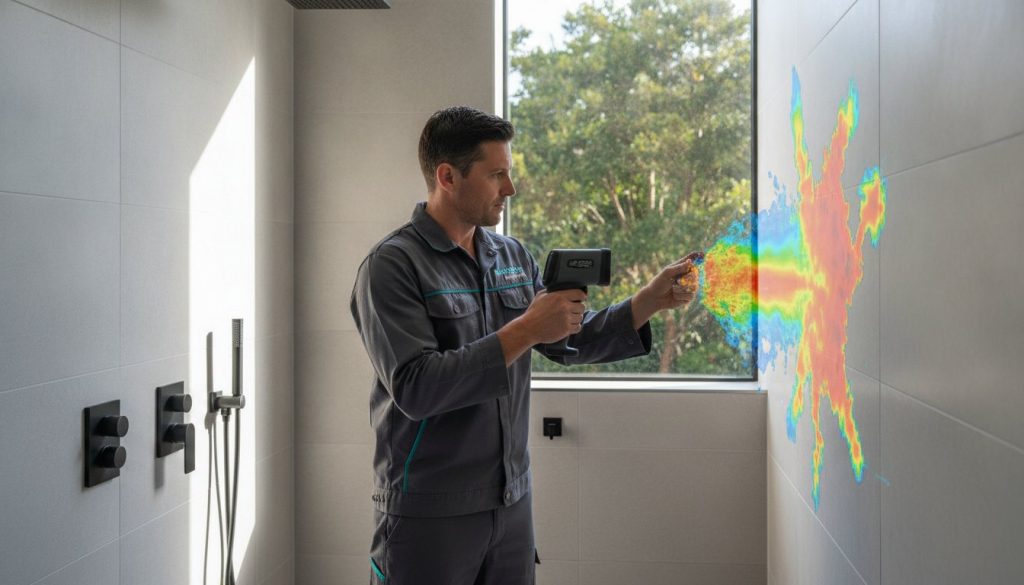
Imagine opening your latest water bill to find a total that has suddenly doubled, yet there isn’t a single damp patch or dripping tap in sight. It’s a stressful scenario many Sunshine Coast homeowners face, especially when the local humidity turns any hidden moisture into a breeding ground for mould. Using thermal imaging leak thermography allows us to find these invisible culprits before they cause lasting structural damage. You know a leak exists, but the fear of a plumber tearing up your expensive bathroom tiles just to find it can be just as overwhelming as the bill itself.
We believe that protecting your home shouldn’t require unnecessary destruction. By using advanced infrared sensors, we can see through your walls and floors to pinpoint the exact source of a leak based on subtle temperature variations. This professional approach identifies the problem quickly and accurately without the need for traditional, invasive search-and-destroy methods. In this article, you’ll discover how this technology saves your property, minimises repair costs, and provides the detailed documentation you need for insurance or body corporate requirements.
Key Takeaways
- Learn how professional thermal imaging allows for precise leak detection without the need to cut into plasterboard or remove expensive bathroom tiles.
- Discover the science of “evaporative cooling” and how thermal imaging leak thermography identifies hidden moisture patterns that are completely invisible to the naked eye.
- Identify the early warning signs of a hidden leak, such as musty odours or unexplained water bill spikes, before they lead to costly structural damage.
- Understand why a multi-tool approach, combining infrared technology with moisture meters and acoustic equipment, provides the most accurate results for your property.
- See how a non-invasive scan provides the professional documentation required for insurance claims while ensuring repairs are focused only on the exact source of the leak.
What is Thermal Imaging Leak Thermography?
Many homeowners assume that a thermal camera works like a set of X-ray goggles, allowing us to peer straight through bricks and mortar. In reality, thermal imaging leak thermography is far more sophisticated. It’s the science of capturing and analysing infrared radiation. Every object with a temperature above absolute zero emits this energy, which is invisible to the human eye but clear as day to a specialised sensor.
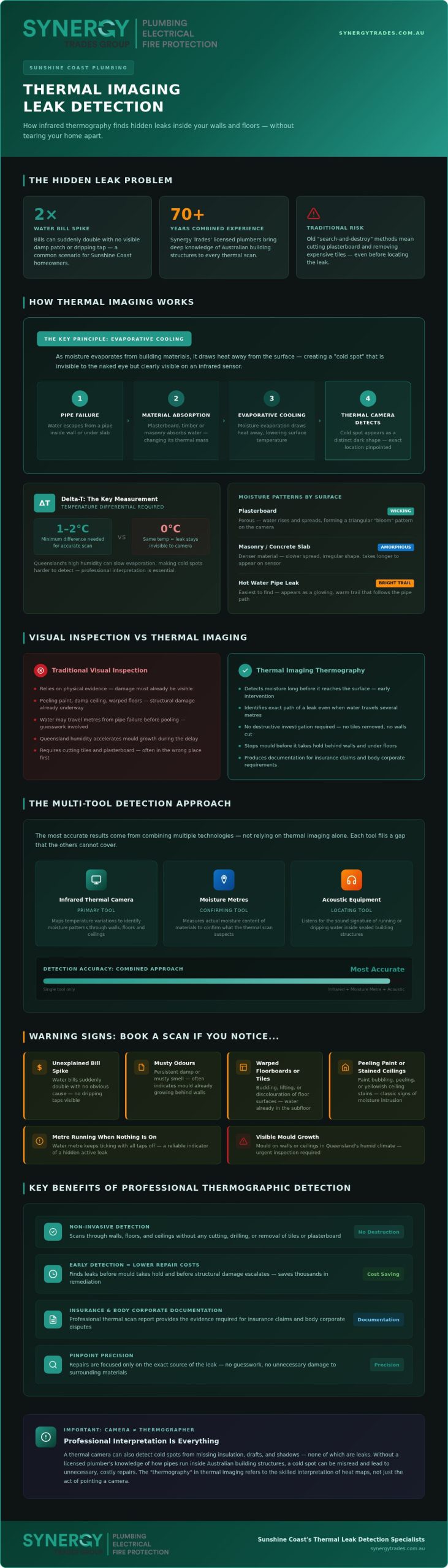
When we ask What is Thermal Imaging in a plumbing context, we’re really talking about mapping heat. The camera doesn’t actually see water. Instead, it detects the “evaporative cooling” effect. As moisture evaporates from building materials like timber or plasterboard, it draws heat away from the surface. This creates a cold spot that appears as a distinct, dark shape on our screen. These thermal signatures tell a story that the naked eye simply can’t read.
The Difference Between Visual and Thermal Inspections
A standard visual inspection relies on seeing physical evidence. By the time you notice peeling paint, a damp patch on the ceiling, or warped floorboards, the structural damage is often already well underway. In the humid Queensland climate, this delay often leads to rapid mould growth behind your walls. A thermal scan finds the moisture long before it reaches the surface. It allows us to identify the exact path of a leak, even if the water is travelling several metres from the actual pipe failure before it pools.
Why “Thermography” is More Than Just a Camera
Owning a high-end camera doesn’t make someone a thermographer. The “thermography” part of the name refers to the professional interpretation of these heat maps. Many things can cause a cold spot, such as a lack of insulation, a draft, or even a shadow. This is where our 70 years of combined trade experience becomes vital. As licensed plumbers, we don’t just find a blue blob on a screen; we understand the internal anatomy of your home. We know where the pipes should be and how water behaves within Australian building structures. This expertise ensures we don’t mistake a natural thermal bridge for a burst pipe, saving you from unnecessary repairs and providing the peace of mind you deserve.
The Science of Finding Hidden Water Leaks
Finding a leak isn’t just about pointing a camera; it’s about understanding how water changes the physical properties of your home. In Australia, we mostly deal with plasterboard, timber framing, and masonry. Each of these materials has a different thermal mass. When water enters the equation, it increases that material’s ability to absorb and hold heat. This is why thermal imaging leak thermography is so effective. Wet plasterboard holds onto temperature differently than dry plasterboard, creating a visible contrast on our sensors.
Success in this field relies on something called “Delta-T.” This is the temperature difference between the wet area and the surrounding dry material. For an accurate scan, we typically need a difference of at least one or two degrees. If the water and the wall are exactly the same temperature, the leak stays invisible. For those interested in the technical specifics, this practical guide to thermal leak detection explains how professionals use these temperature signatures to identify moisture patterns behind various surfaces.
Common Moisture Patterns in Residential Homes
Water behaves differently depending on the surface it hits. In a standard Sunshine Coast home, a leak behind a plasterboard wall often creates a distinct “wicking” pattern. Because plasterboard is porous, the water travels upwards and outwards, forming a shape that looks like a rising triangle or a spreading bloom. On masonry or concrete slabs, the pattern is usually more amorphous and slower to change. We look for these specific shapes to determine if we’re seeing a genuine pipe failure or just a patch of missing insulation. If you suspect a leak but can’t find the source, our team can provide specialised water leak detection to give you answers without the guesswork.
The Role of Ambient Temperature and Humidity
Hot and cold water leaks present very differently on our screens. A burst hot water line is often the easiest to find, appearing as a bright, glowing trail of heat that follows the pipe’s path. Cold water leaks are more subtle. They rely on the evaporative cooling effect mentioned earlier, appearing as dark, “cold” spots. In the high humidity of Queensland, managing the environment is crucial. High humidity can slow down evaporation, making those cold spots harder to see. This is why we use professional-grade equipment with high thermal sensitivity, known as NETD (Noise Equivalent Temperature Difference). Our cameras can detect temperature variations as small as 0.03°C, ensuring we catch even the smallest damp patches before they turn into a major mould problem.
Key Benefits of Professional Thermographic Detection
Choosing professional thermal imaging leak thermography provides more than just a high-tech view of your pipes. It offers a level of certainty that traditional plumbing methods simply can’t match. In the past, finding a leak behind a shower wall often involved a “best guess” approach. A plumber might remove several tiles only to find the pipe was actually failing a metre further down the line. Today, we use infrared technology to pinpoint the exact source of trouble to within a few centimetres, ensuring repairs are surgical rather than destructive.
The advantages of this non-invasive approach extend across the entire property. Because a scan is so efficient, we can assess multiple rooms in a single visit. This speed allows us to identify various hidden issues, such as:
- Rising damp in masonry walls that hasn’t reached the surface yet.
- Failing waterproofing in bathrooms or on balconies before structural rot sets in.
- Multiple leak points in older properties where several pipes might be nearing the end of their lifespan.
- Heat loss or insulation gaps that might be driving up your energy bills.
Saving Money by Avoiding “Search and Destroy” Plumbing
The most significant financial benefit isn’t the scan itself; it’s the demolition and restoration costs you avoid. Replacing a whole bathroom of expensive tiles because you couldn’t find the source of a damp smell is a massive, unnecessary expense. By identifying the issue accurately the first time, we minimise the repair footprint. We don’t believe in making a mess just for the sake of it. Instead, we find the problem, show you the evidence, and then fix the specific area that needs attention. This targeted method keeps your repair bills lower and your home intact.
Providing Evidence for Insurance and Body Corporates
If you live in a strata-titled complex or are making a claim through your home insurance, you know that “I think there’s a leak” isn’t enough. Insurance companies and body corporates require definitive proof before they approve funding for repairs. A professional thermographic report provides the visual evidence required to move your claim forward. We provide high-resolution images that clearly show the extent of moisture spread. This documentation is particularly vital for Sunshine Coast apartment owners where a leak in one unit might be causing damage to the ceiling of the unit below. It shifts the conversation from speculation to hard facts, helping you resolve disputes and get your home back to normal faster.
When Should You Book a Thermal Leak Scan?
If your latest water bill shows a sudden spike without a change in your household habits, you likely have a concealed leak. While a running toilet or a dripping garden tap is obvious, a pinhole leak in a wall cavity can waste hundreds of litres a day without leaving a puddle. Sunshine Coast residents also have to contend with high humidity, which can mask the early signs of a leak by making everything feel slightly damp. Using thermal imaging leak thermography allows us to separate environmental moisture from a concentrated plumbing failure. Common red flags include:
- Unexplained increases in monthly water costs
- The sound of running water when all taps are off
- A water meter that continues to spin despite no usage
- Low water pressure in specific areas of the home
The most common reason people call us is a persistent, musty odour that remains despite cleaning. In the Queensland heat, hidden moisture quickly turns into a mould problem. If you notice your skirting boards are starting to swell or your timber floorboards feel slightly cupped, water is likely present underneath. These subtle physical changes are your home’s way of telling you there’s a problem that needs professional attention.
Signs of Hidden Leaks in Your Walls and Ceilings
Keep a close eye on any changes to your interior finishes. Peeling paint, bubbling wallpaper, or a faint yellowish stain on the ceiling are all indicators of trapped moisture. Because water follows the path of least resistance, the entry point might be several metres away from where the stain appears. Using thermal imaging leak thermography, we can track that moisture trail back to its exact origin. This prevents you from repairing a ceiling only for the stain to return a month later because the actual leak was never found.
Using Thermography for Gutter and Roof Integrity
Our local storm season brings intense, horizontal rain that tests the limits of any roof. After a heavy downpour, we often use infrared technology to inspect ceiling voids for signs of gutter overflow or roof tile failure. Thermal imaging is incredibly effective at identifying wet insulation, which stays cooler than the surrounding dry materials long after the rain has stopped. Identifying these ingress points early can save you thousands in structural repairs and prevent the health risks associated with mould. If you’ve noticed any of these red flags, book a professional leak detection service to protect your property before the damage spreads.
The Synergy Trades Approach to Leak Detection
At Synergy Trades Group, we don’t just rely on one piece of technology. While thermal imaging leak thermography is a powerful tool in our arsenal, it works best when backed by decades of hands-on plumbing knowledge. Paul and Lynda have built this family-owned business on over 70 years of combined trade experience. This means when we look at a thermal scan, we aren’t just seeing colours; we’re seeing the internal structure of your Sunshine Coast home. We understand how water interacts with local building materials and where pipes are likely to fail.
Our Professional Diagnostic Workflow
A truly accurate diagnosis requires a multi-tool approach. We don’t guess, and we don’t leave things to chance. Using thermal imaging leak thermography as our starting point allows us to narrow down the search area before we employ more targeted sensors. Our diagnostic workflow involves three distinct layers of verification:
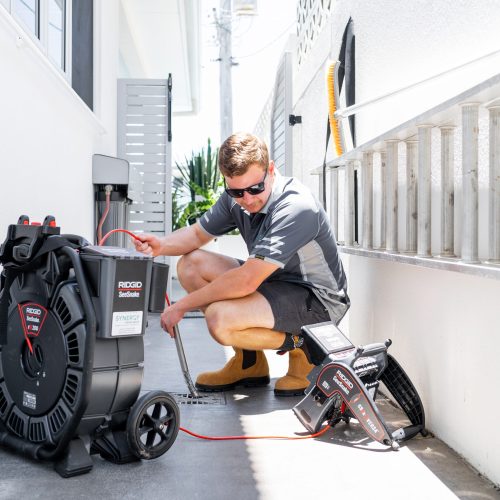
- Thermal Scanning: We use high-sensitivity infrared cameras to map surface temperature variations and identify moisture patterns behind walls and floors.
- Acoustic Detection: We use specialised microphones to listen for the specific frequency of water escaping under pressure, even through concrete slabs.
- Moisture Metering: We verify our findings with non-invasive moisture meters to confirm the physical presence of water behind the surface.
This process ensures that by the time we provide your report, we’ve triangulated the exact location of the problem. We then explain these findings in plain English. You won’t be left decoding technical jargon or complex heat maps; we’ll show you exactly where the leak is and explain the most efficient way to fix it.
Why Local Sunshine Coast Expertise Matters
Living and working on the Coast means we understand the unique challenges of our environment. From the salt air’s impact on fittings to the way tropical humidity affects building materials, our local knowledge is built into every inspection. We’re a family business that values personal connection and transparency. This is why we position ourselves as your trusted expert guide through what can be a very stressful experience.
One of the biggest advantages of choosing Synergy Trades Group is that we are licensed plumbers who can actually fix the leak we find. Many leak detection companies are only qualified to provide a report, leaving you to find another tradesperson to perform the repair. We offer a seamless transition from detection to resolution. Because we’ve already pinpointed the source, we can perform the repair with surgical precision, minimising the mess and the cost to you. It’s a “no-fuss” service designed to give you back your peace of mind.
Protect Your Home with Precision Detection
Hidden water leaks don’t have to result in a renovation nightmare. By choosing thermal imaging leak thermography, you’re opting for a non-invasive solution that pinpoints problems without damaging your bathroom or kitchen. This technology identifies moisture patterns in real-time, allowing for surgical repairs that save you time and money. As a family-owned and operated local business, we bring over 70 years of combined industry experience to every Sunshine Coast property we visit.
We don’t just find the leak; we provide the comprehensive reports you need for insurance purposes and have the plumbing expertise to fix the issue on the spot. Taking action early ensures your home remains safe and your water bills stay under control. Our local experts are ready to help you restore your peace of mind with a “no-fuss” professional service. Book your professional leak detection scan with Synergy Trades today and protect your property from the inside out. We’re here to help you get things back to normal quickly and efficiently.
Frequently Asked Questions
Can thermal imaging see through walls or floor tiles?
Thermal cameras don’t see through solid objects like an X-ray. Instead, they detect infrared radiation emitted from the surface of walls or tiles. When a leak occurs behind a surface, it changes the temperature of that material through conduction or evaporative cooling. Professional thermal imaging leak thermography allows us to visualise these heat patterns. We then interpret these thermal signatures to locate the source of moisture without having to remove any tiles or plasterboard.
Will thermal imaging find every type of water leak?
While highly effective, thermal imaging won’t find every single leak in isolation. It relies on a measurable temperature difference between the wet area and the dry surroundings. If a leak is very deep underground or the water is exactly the same temperature as the wall, it might not show up. This is why we use a multi-tool approach, combining infrared scans with acoustic microphones and moisture meters to ensure we find the culprit every time.
Is thermal leak detection covered by my home insurance?
Many Australian home insurance policies include “trace and access” cover, which often pays for professional leak detection services. This typically covers the cost of finding the leak, even if the repair itself is subject to different terms. We provide high-resolution thermal reports that serve as professional evidence for your insurer. It’s always best to check your specific Product Disclosure Statement (PDS) or speak with your insurance provider to confirm your level of cover.
How much does a professional thermal imaging scan cost on the Sunshine Coast?
The cost of a professional inspection on the Sunshine Coast depends on the size of your home and the complexity of the plumbing system. A single bathroom scan is generally quicker and more affordable than a full-property inspection. While we don’t provide fixed pricing without knowing the details of your situation, the investment is significantly lower than the cost of exploratory demolition. We focus on providing a thorough, no-fuss service that saves you money on repairs.
Can I just buy a cheap thermal camera and find the leak myself?
You can buy entry-level cameras, but they often lack the thermal sensitivity required to find subtle leaks. Professional-grade equipment can detect temperature variations as small as 0.03°C, which is essential for finding cold water leaks in humid Queensland conditions. More importantly, finding a blue spot on a screen is only half the battle. Our 70 years of trade experience allows us to correctly interpret those images and distinguish between a leak and structural thermal bridging.
How long does a typical thermographic inspection take?
A typical thermographic inspection usually takes between one and two hours to complete. This timeframe allows us to scan all high-risk areas, including bathrooms, kitchens, and laundry rooms. If we are performing a whole-house scan or checking for roof integrity after a storm, it might take a little longer. We work efficiently to minimise disruption to your day while ensuring we are thorough enough to provide an accurate, dependable report for your peace of mind.
What happens after the leak is found with the camera?
Once we’ve pinpointed the leak, we’ll explain the findings and show you the thermal images. Because we are licensed plumbers, we can provide you with an immediate plan for the repair. You won’t need to call another tradesperson to interpret our report. We can often perform the fix with minimal damage to your home, focusing only on the exact spot identified during the scan. This seamless process takes you from detection to resolution without the stress.
Does thermal imaging work on both hot and cold water pipes?
Yes, thermal imaging is highly effective for both hot and cold water systems. A hot water leak is often very obvious, appearing as a bright, glowing heat trail on our screen. Cold water leaks are more subtle and rely on the evaporative cooling effect, where the moisture makes the building material appear as a dark, “cold” spot. Our advanced thermal imaging leak thermography equipment is sensitive enough to pick up both types of temperature signatures accurately.