A water filter isn’t a one-size-fits-all answer. For clean drinking water, the right approach depends on the source and the concern: filtration may suit some water-quality needs, while other situations call for testing, maintenance or following official advice. A filter won’t replace precautions during a boil water notice.
It’s reasonable to want confidence in the water you drink, whether it comes from a household tap, a rainwater tank or a bore. This guide explains how to assess tap water, manage a private supply, respond to a boil water notice and reduce risks from water sitting in pipes or outlets.
You’ll also learn what to consider before choosing filtration and when plumbing support can help with leaks, backflow or a filtration system that needs attention.
Key Takeaways
- For rainwater tanks and bores, consider how the water is collected, stored and maintained when assessing whether it’s suitable for drinking.
- The World Health Organization reports that at least 1.7 billion people worldwide used a drinking-water source contaminated with faeces in 2022, underscoring why water quality matters.
- During a boil water notice, follow the instructions issued for your area and wait for the notice to be lifted before returning to normal use.
- After water has been sitting unused, flushing the outlet can draw fresher water through. The recommended time depends on the tap and how long it has been idle.
- Learn how Australian drinking-water quality is managed, and where plumbing maintenance such as gutter cleaning or backflow testing may help protect a property’s water system.
Private supplies such as rainwater tanks and bores
Rainwater tanks and bores can provide household water where a mains supply isn’t available. Water quality depends on the catchment or groundwater, storage conditions and any treatment used. A supply that looks clear can still contain contaminants, so appearance alone can’t establish whether it’s suitable for drinking.
Rainwater quality can be affected by the roof, gutters, nearby trees and anything entering the tank. Leaves, bird droppings and other debris on a roof, for example, can wash into the tank during rainfall. A covered tank with a secure inlet can help keep out animals and debris, while regular roof and gutter checks can reveal visible build-up. These steps support good maintenance, but don’t prove the water is safe to drink.
Bore water has different considerations. Ground conditions and nearby land use can affect what enters groundwater, and quality may vary between properties. Clear appearance or a familiar taste doesn’t show whether bore water contains microorganisms or chemicals. Testing is the practical way to identify concerns and determine which treatment, if any, is relevant. Treatment should suit the issue found: a filter designed for one contaminant may not address another.
For either source, consider the whole path from collection to tap. Check that tanks are covered and pipes and fittings are intact, and use a clean container if water is moved. Follow treatment equipment maintenance instructions, including replacing filter parts as directed. If the water changes colour, smell or taste, don’t rely on those signs alone to judge its quality. Arrange suitable testing before deciding how to use the supply for drinking or food preparation.
The World Health Organization reports that at least 1.7 billion people worldwide used a drinking-water source contaminated with faeces in 2022. This is a global figure, not a measure of Australian private supplies, but it highlights why water quality can’t be assessed by appearance alone. Access to safe water also depends on sanitation and hygiene, as contamination can occur between collection, storage and use.
The United Nations’ Sustainable Development Goal 6.1 sets a target of universal and equitable access to safe and affordable drinking water for all by 2030. At home, a practical approach is to identify the source, protect storage, test when quality is uncertain and match treatment to the results. This helps households manage a private supply responsibly rather than assuming that rainwater or bore water is automatically safe.
Boil water notices and precautions
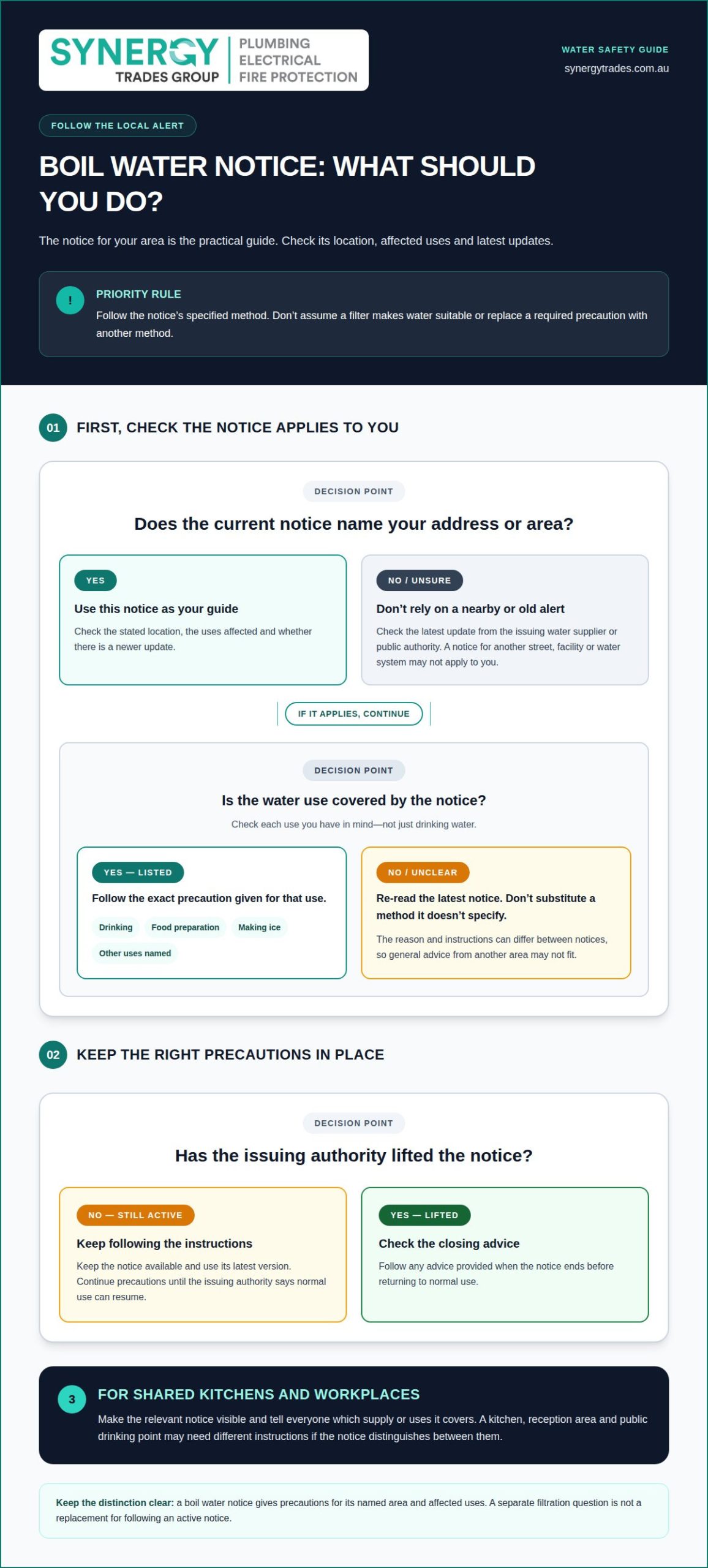
A boil water notice is a public warning to take extra care with tap water. Its instructions explain which uses are affected and what precautions apply.
Understanding boil water notices
A notice tells people in an affected area that extra precautions are needed before certain uses of tap water. The reason and instructions can differ, so read the notice itself rather than relying on general advice from another suburb or an older alert. Check its stated location, affected uses and updates. This helps households, schools and workplaces understand what to do with their supply.
Precautions during a notice
Precautions are the steps specified in the notice while the warning remains active. Follow the directions for drinking, preparing food, making ice and any other listed uses. Don’t assume a filter makes water suitable, because the notice’s required method takes priority. In a shared kitchen, tell everyone which tap or stored supply to use.
Keep the notice available while you follow it. A message for one street, facility or water system might not apply to every nearby property. Confirm that the named address or area matches yours, then follow updates from the issuing water supplier or public authority. If instructions change, use the latest version rather than an earlier message saved on a phone or noticeboard.
Think through everyday uses, not just filling a drinking glass. A household might use tap water to prepare a meal, rinse produce, fill a kettle or make ice. Compare each use with the notice’s directions. Where the notice gives a specific precaution for a particular use, apply it and avoid substituting an unmentioned method.
At a workplace or community venue, one clear point of communication can prevent mixed messages. Display the relevant notice where staff and visitors can see it, and explain which supply or uses it covers. A kitchen, reception area and public drinking point may need different instructions if the notice distinguishes between them. Keep warnings in place until the issuing authority says normal use can resume.
Notices are precautionary instructions, not a general judgement about every water supply across Australia or other countries. Global figures about water access, millions of people or deaths don’t tell a local household how to use its tap during an alert. The notice’s area, stated reason and current directions are the practical details that matter.
Once the notice has ended, follow any closing advice it provides. If a separate concern remains, such as an ongoing taste issue or a question about household filtration, arrange help with a water filtration concern. A filtration discussion is separate from following an active notice, and shouldn’t replace its instructions.
Drinking water quality standards
Drinking water standards provide a framework for assessing whether water is suitable to drink. In Australia, the Australian Drinking Water Guidelines are published and maintained by the National Health and Medical Research Council and the Natural Resource Management Ministerial Council. They support consistent water quality assessment, rather than relying only on appearance, taste or smell.
Since 2004, the Guidelines for drinking-water quality have promoted a framework for safe drinking water. Their purpose is broader than deciding whether water looks clean: assessment considers whether a supply is safe to drink and how risks can be managed. For a household, this distinction matters because water may appear clear while still requiring further assessment.
There are no universally recognised and accepted international standards for drinking water. A standard developed in another country shouldn’t automatically be treated as Australia’s rule. The Australian framework gives local water suppliers and others assessing a supply a relevant reference, while the source and circumstances still shape what needs attention.
Safe drinking water is also described by how it is delivered. A safely managed service comes from an improved source on the premises, is available when needed and is free from microbiological and priority chemical contamination. This description connects water quality with access: a supply needs to be available and managed, not simply present at a tap.
For a private supply, start by identifying the source and the concern. A rainwater tank and a bore don’t necessarily have the same water-quality profile. Testing can identify what is present, while the relevant guideline provides a basis for interpreting results. Treatment decisions should match the identified issue, rather than assume one filter addresses every possible concern.
Standards also help distinguish a health concern from a change affecting taste or appearance. If a result raises a question, note the substance or characteristic reported, the sample source and the testing context. These details make the result meaningful. A general label such as “clean” can’t explain which contaminants were assessed or whether treatment is suitable.
Water quality is connected to public health, disease and wider water and sanitation conditions. Income can affect access to safe drinking water and the ability to maintain reliable services, but each household still needs an assessment suited to its supply. Use the Australian Drinking Water Guidelines as the local reference point, and base treatment choices on relevant results and the source involved.
Flushing taps after water stagnation
If tap water suddenly looks, smells or tastes unusual, don’t rely on flushing alone to explain the change. Check for a current local water notice and contact the water supplier if the change continues or affects several taps.
After a tap has been unused, water can sit in the plumbing between the pipework and outlet. Flushing draws water through the tap before drinking or cooking. In Victoria, householders can flush cold taps used for drinking and cooking for about 30 seconds first thing in the morning.
Longer periods without use call for a different interval. In Victoria, householders can flush cold taps used for drinking and cooking for about 2-3 minutes after long periods of non-use. This advice is useful after returning from a holiday or reopening a room that has been closed. Use the cold tap, rather than assuming hot water serves the same purpose.
Public outlets need attention too. In Victoria, public drinking water fountains and publicly accessible taps should be flushed for about 30 seconds to draw fresh water to the outlet. This can matter at a school, park or community facility after a tap has been idle. Follow any local instructions displayed at the fixture.
- At home: Flush the cold drinking and cooking tap for about 30 seconds first thing in the morning in Victoria.
- After an absence: Flush the cold tap for about 2-3 minutes after a long period without use.
- At a public outlet: Flush a fountain or publicly accessible tap for about 30 seconds in Victoria.
Water left in a jug can also affect taste. In Victoria, water can be left in a jug for a few hours to reduce chlorine taste and odour before drinking. Leaving water in a jug may help with taste or odour, but it should not be treated as a solution to every water concern. Don’t use this approach instead of following instructions in a current notice.
Flushing is a practical step for water that has been sitting in a tap or outlet. It doesn’t establish that a water source is safely managed or suitable in every circumstance. Global access to safe water depends on sustainable systems, while an individual tap still needs local advice if unusual changes persist.
For example, if only one bathroom tap tastes different, the issue may be limited to that outlet or its nearby pipework. If several taps change together, the water supply or a wider plumbing issue may be involved. Note which outlets are affected and when the change began. This information can help distinguish a local fixture concern from a change affecting the property’s supply.
How is tap water treated and monitored in Australia?
Tap water management in Australia involves treatment and monitoring, but arrangements depend on the water supply and location. The Australian Drinking Water Guidelines are published and maintained by the National Health and Medical Research Council and the Natural Resource Management Ministerial Council. They provide a national reference for understanding drinking-water quality.
Treatment is planned around the source water and the risks that could affect it. A supplier’s risk management plan sets out how those risks are identified and managed, rather than relying on water’s appearance at the tap. The plan also needs regular review, so identified hazards and management measures can be reconsidered as circumstances change.
In Victoria, the Safe Drinking Water Act 2003 requires drinking water suppliers to develop, implement and review risk management plans. This is a Victorian requirement, not a statement of the rules in every Australian state or territory. It shows how planning can connect the water source, treatment decisions and ongoing oversight within a defined system.
Monitoring provides information about the quality of supplied water. Victorian water suppliers are required to report annually on the quality of the drinking water they supply, including chemicals added to it. An annual report can help readers understand reported water quality and treatment context. It is different from a test of water inside an individual property.
That distinction matters. A supplier’s monitoring describes the supply it manages, while a property’s plumbing can affect water after it enters the building. A change at one tap may be local to the fixture or pipework, for example, while a change across several taps may point to a wider issue. The location and pattern help frame the next investigation.
For a household, useful information includes the water supplier, the property’s supply type and the taps affected. If a public notice applies, follow its instructions rather than treating a filtration device as a substitute. If the concern is limited to taste, odour or one outlet, describe what changed and where. These details help separate supply questions from plumbing or treatment concerns.
Private rainwater and bore supplies differ from treated public supplies because their collection, storage and maintenance conditions are different. A general guideline can inform assessment, but the source and test results matter when selecting treatment. Match a filter to the issue it is intended to address rather than assuming it removes every possible contaminant.
If you’re considering household filtration, book a water filtration service to discuss the system and concern involved.
Synergy Trades Group: Gutter Cleaning
Synergy Trades Group provides gutter cleaning to help prevent leaves and debris building up around your roof’s drainage system. For homes collecting rainwater, clean gutters support upkeep of the catchment before water reaches the tank. Gutter cleaning doesn’t test or treat stored water, so pair it with appropriate tank maintenance and water-quality checks.
If blocked drains or a backflow concern affects your property’s plumbing, Synergy Trades Group also provides blocked drain clearing and RPZ backflow testing. These services address specific plumbing issues; they don’t replace water testing or instructions during a boil water notice.
If your gutters need attention, contact Synergy Trades Group to discuss gutter cleaning.
Make water care part of your home maintenance
Confidence in clean drinking water comes from understanding what your supply needs and keeping the surrounding plumbing in sound condition. A useful next step is to note any changes, identify whether they affect one fixture or the whole property, and match maintenance to the issue rather than relying on guesswork.
For plumbing concerns around your property, Synergy Trades Group offers Hot Water System Repairs, Blocked Drain Clearing and RPZ Backflow Testing. These services address specific maintenance needs, while water testing and public health advice remain important for water-quality questions. Choosing the right support starts with describing the problem clearly, including where it occurs and what has changed.
If you’re ready to discuss a plumbing maintenance concern, contact Synergy Trades Group. A clear account of the issue helps set the conversation on the right track, so you can take a considered next step for your home.
Frequently Asked Questions
What about filtering tap water?
A filter can address a specific concern, but it isn’t automatically needed for every tap. First identify whether the issue is taste, odour or a particular contaminant, then choose a filter designed for that purpose. Follow its installation and cartridge replacement instructions. For clean drinking water, filtration shouldn’t replace local water advice or instructions during an active notice.
What are the benefits of safe water supply and sanitation?
A safe supply supports drinking, cooking and everyday hygiene, while effective sanitation helps keep human waste away from water sources. Together, these services reduce opportunities for contamination to spread through households and communities. Safe water for washing hands and preparing food, for example, supports everyday hygiene. A reliable supply also makes it easier for homes, schools and workplaces to meet daily needs.
What are the challenges?
The main challenge is that water risks differ by source and location, so one treatment approach won’t suit every supply. Rainwater storage, groundwater and public networks each have different conditions to manage. Equipment needs appropriate upkeep, and a filter’s usefulness depends on the contaminant it targets. During a local disruption, clear instructions matter because routine household practices may need to change.
What makes drinking water safe to drink in Australia?
Assessment considers whether water is available when needed and free from microbiological and priority chemical contamination. The Australian Drinking Water Guidelines, maintained by the National Health and Medical Research Council and the Natural Resource Management Ministerial Council, provide a reference for water quality. At home, remember that a supply report and the condition of plumbing inside a property address different parts of the water journey.
Is Australian tap water safe to drink in every state and territory?
There isn’t a single answer for every tap at every moment. Water management and local circumstances vary, and a temporary notice can apply to a particular area or supply. Check whether an alert names your location and follow its instructions. Private supplies also need separate consideration, since a public water supplier’s monitoring doesn’t describe a household tank or bore.
How can I check drinking water quality in my local area in Australia?
Start with your water bill or account information to identify the supplier serving your address. Look for the supplier’s current quality information and notices, and check that the location matches your suburb. Note whether the concern affects several taps or just one. Supplier information describes the network supply, while a change limited to one outlet may involve plumbing within the property.
Do water filters improve drinking water safety, and which types are effective?
A filter can help when its treatment method matches the contaminant of concern, but no single type addresses every possible issue. Use water test results or relevant supplier information to identify what needs attention, then check the filter’s stated purpose and maintenance requirements. Replacing a cartridge as directed matters. A household filter doesn’t override a boil water notice or other local public health instructions.
How can I make water safe to drink during a boil-water alert or emergency?
Follow the current notice’s exact instructions for your area and each affected use. It will tell you what precautions to take and when they apply. Don’t assume a domestic filter makes water suitable or use an approach from a different alert. If there’s an emergency without a clear notice, follow instructions issued by the relevant local public authority.