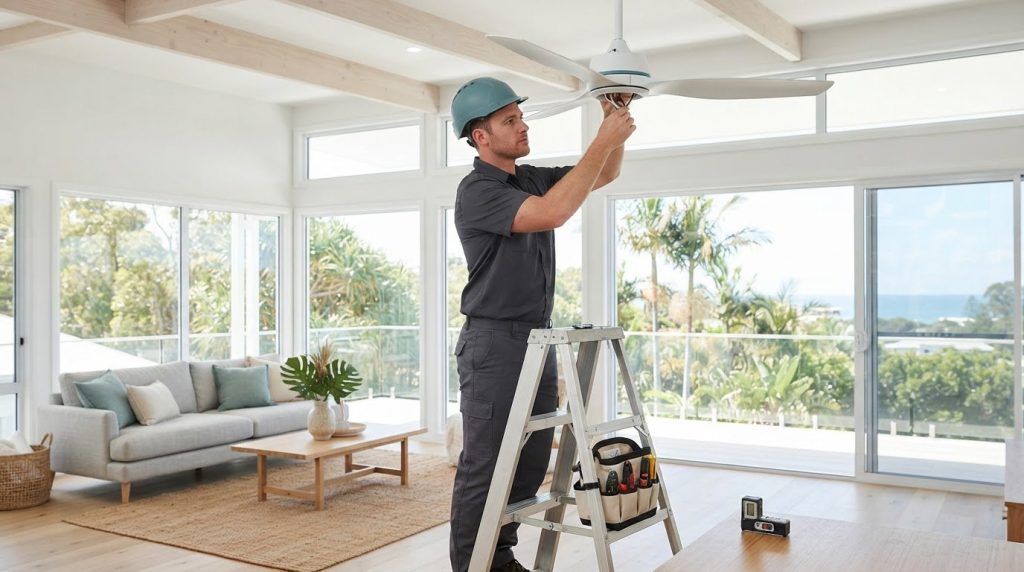
The stylish timber-bladed fan you spotted in a showroom often droops into a noisy, wobbling mess after just one humid Sunshine Coast summer. Choosing the right ceiling fan for our subtropical climate isn’t just about matching your interior decor; it’s about protecting your home against salt air corrosion while keeping your seasonal power bills manageable.
If you feel confused by the differences between DC and AC motors, or worried that coastal humidity will pit and rust your new fittings, you aren’t alone. You shouldn’t have to put up with irritating ceiling rattles or rely solely on expensive air conditioning to survive January heatwaves. Discover how to choose the right ceiling fan for Queensland coastal living, cut cooling bills, and ensure safe, compliant installation. We will cover the best moisture-resistant materials, proper airflow sizing for indoor and outdoor spaces, and the legal electrical requirements every homeowner must know before installing.
Key Takeaways
- Understand the convective cooling principles that make a ceiling fan dramatically cut your household air conditioning reliance.
- Compare the energy savings, whisper-quiet operation, and long-term running costs of DC motors against traditional AC units.
- Identify coastal-grade materials like rust-proof ABS polymer to prevent blade sagging, pitting, and salt spray damage.
- Measure room dimensions and ceiling clearances accurately to secure optimal airflow while meeting Australian safety standards.
- Learn why Queensland electrical safety regulations require licensed installation and how dedicated switchboard protection keeps your home safe.
Understanding Ceiling Fans: Cooling Principles, Airflow, and Efficiency
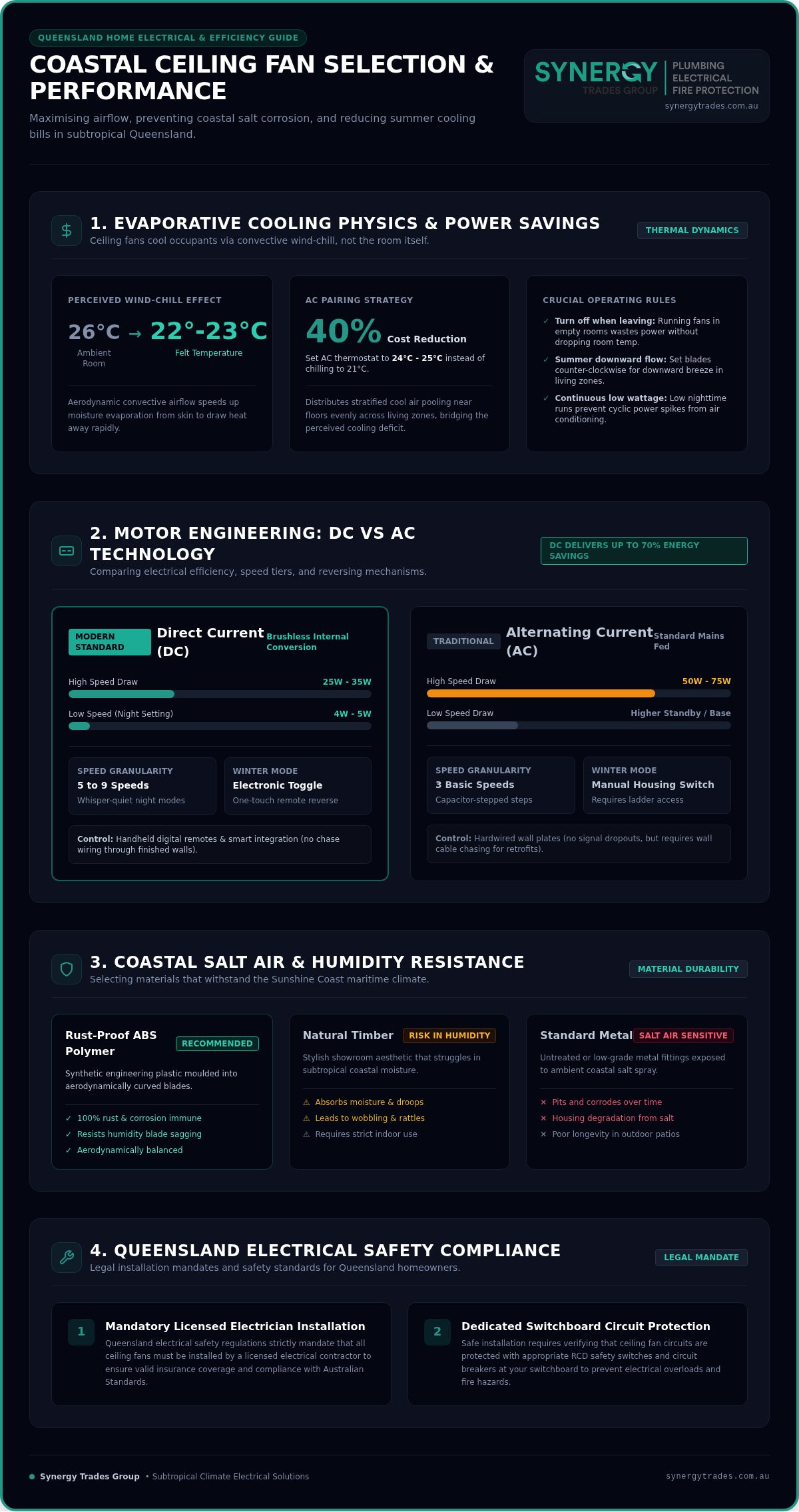
Many homeowners assume a ceiling fan works like a miniature refrigeration unit. In reality, ceiling fans cool people rather than spaces. They do this by establishing a steady breeze that speeds up the natural evaporation of moisture from your skin. This aerodynamic convective cooling creates a pronounced wind-chill effect, making an ambient room temperature of 26°C feel closer to 22°C or 23°C. For a comprehensive overview of ceiling fans and their mechanical evolution, the physics remains straightforward: they move air across your body to draw heat away fast.
The Mechanics of Evaporative Cooling Indoors
Because these units work through airflow contact, running a ceiling fan inside an empty room achieves nothing. A fan left spinning in an unoccupied bedroom simply wastes electricity while the motor gradually radiates trace heat into the ceiling cavity. The physical thermometer reading never drops on its own. To maximise daily performance and minimise unnecessary wear, follow these simple usage habits:
- Turn them off when leaving: Treat fans like lighting circuits; only run them when a room is physically occupied.
- Select downward summer airflow: Check that the blades spin counter-clockwise to drive airflow directly downwards towards living zones.
- Maintain continuous low-wattage operation: Keep units running on lower speeds during warm evenings rather than cycling high-power cooling appliances on and off.
How Fans Dramatically Reduce Summer Air Conditioning Costs
Pairing a ceiling fan with split-system air conditioning delivers substantial power bill relief during humid coastal summers. Air conditioners consume significant electricity when forced to chill air down to 21°C. Instead, you can set your thermostat comfortably to 24°C or 25°C and let the fan handle the perceived cooling deficit. Running both systems in tandem can reduce air conditioning operational costs by up to 40%.
Cold air naturally sinks and pools near your floorboards, leaving warmer air trapped around head height. A spinning ceiling fan circulates these stratified temperature layers, breaking up cold pockets and distributing treated air evenly across open-plan living rooms. If you want tailored recommendations on optimising whole-home comfort across our Sunshine Coast service area, balancing efficient air movement with sensible thermostat management is the most practical place to begin.
DC vs AC Motor Ceiling Fans: Which Technology Is Better?
Motor type represents the most critical decision when updating your home’s air circulation. Traditional alternating current (AC) models have anchored Queensland ceilings for decades, offering mechanical simplicity and lower upfront hardware costs. Modern direct current (DC) motors convert mains power internally, delivering up to 70% greater energy efficiency for equivalent air volume. Recognised benchmarks like the energy efficiency standards for ceiling fans clearly demonstrate how brushless DC engineering minimises power waste while extending motor lifespans.
Energy Consumption and Speed Control Breakdown
The gap in operating wattage between the two motor types becomes glaring over long summer runs:
- Running power: A standard AC fan draws between 50 and 75 watts on high. A DC equivalent pushes identical cubic metres of airflow using just 25 to 35 watts, dropping to roughly 4 or 5 watts on gentle low settings.
- Granular speed options: AC models are usually limited to three basic speeds via a wall capacitor. DC systems offer five to nine distinct speed tiers, making it easy to find a whisper-quiet nighttime breeze that will not disturb light sleepers.
- Winter reverse mode: Reversing an AC unit requires climbing a ladder to flick a physical housing switch. Modern DC handpieces toggle blade direction electronically at the press of a button, circulating warmth trapped near high ceilings during cooler winter months.
Wall Switches vs Remote Controls vs Smart App Integration
Control preferences often dictate which technology suits your household best. Traditional AC setups connect cleanly to robust, hardwired wall plates. They rarely suffer signal drops, and you will never misplace a handheld remote down the couch cushions. However, wiring new three-speed wall switches into finished plasterboard walls requires additional cable pathways, which can complicate retrofits in multi-storey builds.
DC models rely almost exclusively on digital wireless controllers or integrated smartphone apps. Digital setups simplify electrical runs because the motor requires only an active feed rather than dedicated multi-core switch wiring. Wi-Fi enabled DC models also let you automate schedules based on ambient room humidity or link into Amazon Alexa and Google Assistant ecosystems. When outfitting several bedrooms at once, your electrician will simply pair unique digital frequencies to each receiver to avoid cross-room interference. If you are weighing up motor compatibility against your property’s existing switchboard, you can easily schedule an electrical assessment with our experienced trade team.
Choosing Coastal-Proof Fan Materials for Sunshine Coast Homes
Living along the Sunshine Coast means dealing with relentless salt air and dense humidity. Airborne salt particles settle onto household surfaces daily, triggering galvanic corrosion on standard metal brackets and chewing through cheap powder coatings. Selecting a ceiling fan with the wrong construction materials leads to pitted motor bodies, sagging blades, and annoying mechanical squeaks long before the motor itself wears out.
ABS Plastic Composite vs Metal and Natural Timber Blades
Blade material directly dictates how well your fixture survives coastal exposure over time:
- UV-stabilised ABS polymer: Acrylonitrile Butadiene Styrene (ABS) is the gold standard for coastal properties. Injection-moulded ABS blades are lightweight, impervious to moisture, and chemically stable. They will not corrode, droop, or absorb dampness, and quality UV stabilisers prevent yellowing in sunny living rooms.
- Natural timber and plywood: While timber looks warm and organic, natural grain absorbs ambient moisture during humid summer storms. As the wood swells unevenly, the blades warp. This minor weight variation throws the motor out of balance, causing irritating wobbles and premature bearing wear.
- Marine-grade 316 stainless steel: Standard 304 stainless steel or pressed aluminium will tea-stain and pit within months near the ocean. If you prefer metallic finishes, insist on 316 marine-grade hardware to resist heavy chloride attack.
Alfresco and Outdoor Installation: Understanding IP Ratings
Installing a ceiling fan under an outdoor patio requires strict attention to Ingress Protection (IP) ratings. Standard indoor models lack protective motor seals, allowing driving rain and moist coastal breezes to seep into electrical components. For an undercover alfresco deck shielded by solid perimeter walls, an IP44 rating offers robust resistance against splashing water and windborne grit.
Fully exposed pergolas or open-sided gazebos face direct, wind-driven downpours. These open structures demand IP55 or IP66 units built with hermetically sealed motor housings. Keep in mind that even the toughest outdoor fittings require regular care. A simple wipe-down every few months with a damp microfiber cloth and warm fresh water clears away corrosive salt crusts, protecting your motor casing and maintaining quiet, wobble-free operation for years to come.
Room Sizing, Blade Span, and Placement Guide
Selecting the right ceiling fan requires balancing physical dimensions with proper spatial geometry. A fan that is too small for a master bedroom will spin furiously while moving barely any air. Conversely, an oversized unit crammed into a study creates an overwhelming draught and risks hitting nearby furniture. Careful layout planning ensures your fan delivers balanced airflow without compromising room safety.
Matching Blade Sweep (Diameter) to Room Dimensions
Blade sweep describes the full diameter from blade tip to blade tip. Use these general floor measurements to pair the right unit to each zone:
- Compact bedrooms and studies (up to 12m²): A 48-inch (122cm) sweep circulates ample air without dominating smaller plasterboard ceilings.
- Standard bedrooms and secondary living areas (12m² to 20m²): A 52-inch (132cm) fan hits the ideal balance between wide breeze distribution and motor efficiency.
- Expansive master suites and open living zones (over 20m²): Choose a 56-inch (142cm) or larger blade span. For elongated alfresco patios, installing twin 52-inch fans spaced evenly apart delivers far better convective coverage than relying on a single central fitting.
Ceiling Height Clearance and Downrod Requirements
Australian safety standards mandate that ceiling fan blades must hang at least 2.1 metres above the finished floor level. For modern homes built with standard 2.4-metre ceilings, a standard mounting rod or a low-profile flush-mount hugger fan keeps blades well clear of heads and raised arms.
Pitched, raked, or cathedral ceilings present a different challenge. Mounting a fan directly against a steep roofline can restrict airflow intake above the blades, causing severe motor strain. In these properties, an extension downrod is essential to drop the assembly into open air. You must also maintain at least 300 millimetres of clearance between the blade tips and any sloping ceiling surface or adjacent structural beam.
Downlight Strobing: A Common Layout Mistake to Avoid
Few domestic annoyances compare to the disorienting strobe effect caused by fan blades cutting through recessed downlight beams. When an electrician positions a downlight too close to a spinning blade, it casts a rapid, flickering shadow across the floor that triggers headaches and eye strain.
To avoid this issue, ensure downlights sit outside the fan’s blade sweep by at least 600 millimetres, keeping clear of the downward light cone. Alternatively, selecting a ceiling fan with an integrated central LED light module eliminates strobing altogether while streamlining your ceiling fixtures. If you want professional guidance on positioning fixtures safely across your floor plan, simply book an on-site installation consultation with our experienced Sunshine Coast team.
Queensland Electrical Safety: Why Professional Installation Is Essential
Under the Queensland Electrical Safety Act 2002, connecting any fixed electrical appliance is legally classified as electrical work. Attempting a DIY installation on a ceiling fan is illegal, hazardous, and carries individual fines exceeding $40,000. Beyond regulatory penalties, unlicensed work automatically voids the manufacturer warranty and can invalidate your private home insurance coverage if an electrical fire occurs. Engaging our professional electrical team guarantees that every circuit complies with AS/NZS 3000 wiring standards, finalised with a legally recognized Certificate of Testing and Compliance.
Structural Mounting, Circuit Balancing, and Safety Switches
A ceiling fan produces continuous rotational torque that light-duty plasterboard fixings or standard light junction boxes cannot bear. Bolting a vibrating motor to unsupported plaster causes ceiling sagging, irritating rattles, and eventual mount failure. During installation, our electricians secure dedicated brackets directly into ceiling joists or install solid timber bridging battens across roof trusses to ensure completely wobble-free operation.
Every installation also includes a thorough safety review of your existing switchboard circuits:
- Safety switch verification: We test that the sub-circuit feeding your fan is actively protected by a compliant Residual Current Device (RCD).
- Circuit capacity checks: We confirm your existing lighting loop can handle additional inductive motor loads without nuisance tripping.
- Clearance audits: We verify safe separation distances from attic insulation and ceiling-mounted smoke alarms.
Book Your Sunshine Coast Installation with Synergy Trades Group
Operated by Paul and Lynda, Synergy Trades Group brings over 70 years of combined trade experience to homeowners across the entire Sunshine Coast region. As a family-owned trade business, we prioritize honest communication, punctual arrivals, and spotless cleanups after completing work. Whether you are replacing tired bedroom fittings or wiring a new outdoor entertaining area, we make sure your fans operate smoothly, quietly, and safely. Contact our friendly office today to discuss your ceiling cooling needs and arrange a compliant installation.
Keep Your Home Cool and Protected This Summer
Preparing your home for sweltering coastal humidity comes down to making informed hardware and placement choices. Investing in an energy-efficient DC motor paired with durable ABS composite blades prevents premature salt corrosion and keeps daily cooling bills low. Above all, securing compliant wiring and solid ceiling timber support ensures your new ceiling fan operates quietly and safely for years without annoying rattles or structural hazards.
At Synergy Trades Group, Paul and Lynda bring over 70 years of combined trade industry experience to households across the Sunshine Coast region. As fully licensed and insured Queensland electricians, our family-owned team takes immense pride in delivering dependable, tidy service while verifying that your switchboard safety switches meet modern regulatory standards. When you are ready to upgrade your indoor or alfresco living spaces, contact Synergy Trades Group for licensed ceiling fan installation and enjoy reliable, whisper-quiet breezes all season long.
Frequently Asked Questions
Can I legally install a ceiling fan myself in Queensland?
No, you cannot legally install or replace a ceiling fan yourself in Queensland. Under the Electrical Safety Act 2002, connecting fixed domestic appliances directly to household wiring constitutes licensed electrical work. Unlicensed installations risk fines exceeding $40,000, void your manufacturer product warranties, and can compromise private home insurance policies in the event of an electrical fire.
How much power does a modern DC ceiling fan use?
A modern DC ceiling fan consumes remarkably little electricity, typically drawing between 25 and 35 watts on maximum speed and as little as 4 to 5 watts on low. Running a DC unit on high costs approximately 0.5 cents per hour. That represents up to 70% lower energy consumption compared to traditional AC fans, keeping your summer cooling bills exceptionally low.
Are 3-blade ceiling fans better than 4 or 5-blade models?
Three-blade designs generally move air faster with slightly less aerodynamic drag on the motor, making them very energy-efficient. However, fans with 4 or 5 blades produce a softer, quieter ambient airflow that many homeowners prefer for bedrooms. Aerodynamic blade pitch and modern motor engineering play a far greater role in overall cooling efficiency than blade count alone.
How do I prevent my ceiling fan from rusting near the beach?
Choose fixtures engineered with UV-stabilised ABS composite plastic blades and marine-grade 316 stainless steel mounting hardware. Standard pressed metals corrode rapidly in salt air. For outdoor covered decks, select fans carrying an IP44 or higher ingress rating. Gently wiping down the casing and blades with fresh, warm water every few months prevents corrosive salt encrustation.
Can a ceiling fan be installed on a sloped or raked ceiling?
Yes, but you will need an angled ceiling canopy kit and an appropriate extension downrod. Standard mounting brackets only accommodate gentle slopes. Steeper cathedral or raked rooflines require specialised ball-joint canopies to allow the downrod to hang plumb. You must also maintain at least 300 millimetres of clearance between blade tips and adjacent sloping surfaces.
Why does my ceiling fan wobble or make clicking noises?
Wobbling usually stems from uneven blade weights, bent brackets, or loose mounting screws connecting into the ceiling structure. Clicking or humming sounds frequently indicate poor structural bracing, motor housing misalignment, or an unsupported ceiling junction box vibrating against roof battens. A licensed electrician will balance the blades dynamically and secure the assembly directly into ceiling joists to eliminate rattles.
Can ceiling fans help reduce my air conditioning power bill?
Yes, pairing fans with air conditioning can cut your cooling power usage by up to 40%. The convective breeze allows you to set your air conditioner thermostat 2°C to 3°C higher without sacrificing comfort. Furthermore, the rotating blades continuously redistribute dense cold air pooling near the floor, ensuring consistent temperatures throughout open-plan Sunshine Coast living zones.