If a fire started in your laundry while you were asleep, would the alarm in your bedroom actually wake you up? It’s a sobering thought, and it’s precisely why the Queensland government has mandated a higher standard of protection for every household. We understand that the looming 1 January 2027 deadline for smoke alarm compliance qld is causing plenty of stress. Many homeowners feel stuck between confusing jargon about ‘interconnected photoelectric’ sensors and the fear of losing insurance coverage if they don’t get it right.
Meeting these requirements shouldn’t be a source of anxiety or a race against ‘cowboy’ installers charging premium rates. This guide simplifies the entire process, promising to give you the exact steps needed to protect your home and satisfy the law. We’ll break down the AS 3786-2014 requirements, explain where alarms must be installed, and help you decide between 10-year lithium batteries or hardwired systems. You’ll gain a clear checklist to ensure your family stays safe and your property remains fully compliant well before the deadline arrives.
Key Takeaways
- Prepare for the 1 January 2027 deadline by understanding who is affected, including owner-occupiers, landlords, and caravan owners across the state.
- Navigate the technical requirements for smoke alarm compliance qld, ensuring your home uses interconnected photoelectric sensors that meet Australian Standard AS 3786-2014.
- Choose the right power source for your property, whether it’s 240V mains-powered alarms or sealed 10-year lithium battery units for easier retrofitting.
- Master the ‘every bedroom’ rule and correct hallway placement to ensure your family is alerted no matter where a fire starts.
- Learn how to maintain your safety system against the Sunshine Coast’s humidity and salt air to prevent nuisance alarms and equipment failure.
The 2027 Queensland Smoke Alarm Deadline: Is Your Home Ready?
The clock is ticking toward 1 January 2027. For many Sunshine Coast residents, this date marks the final deadline to ensure their homes meet the updated fire safety standards. Achieving smoke alarm compliance qld isn’t just about ticking a box for the government; it’s about installing a modern safety net that protects your family while they sleep. If you own a house, townhouse, or unit, you’re responsible for this upgrade. Even registered caravans and motorhomes must comply by the same 2027 date, making this a universal requirement for almost every resident in the state.
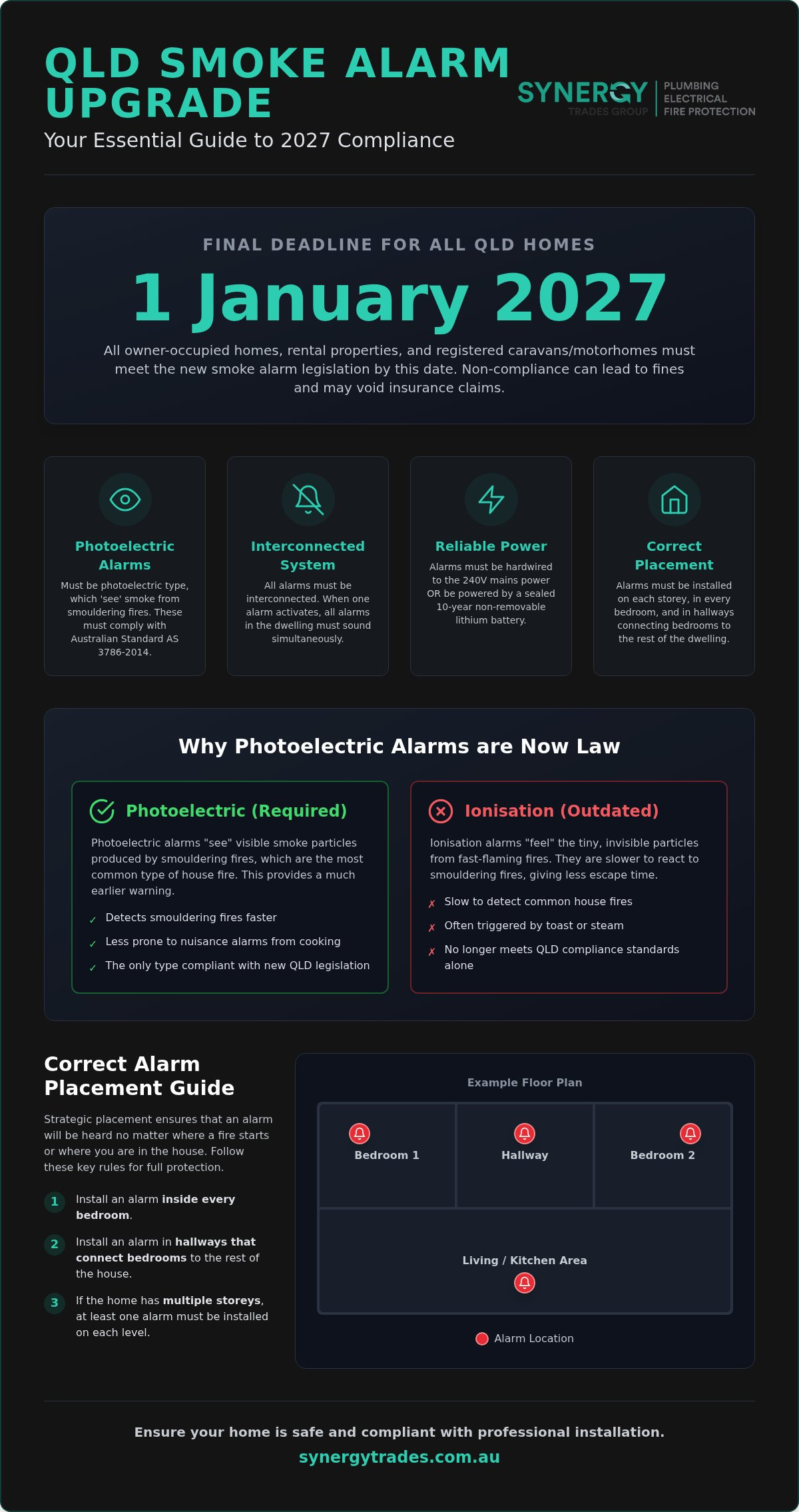
A compliant system must feature photoelectric alarms that meet Australian Standard AS 3786-2014. These alarms must be interconnected and placed in every bedroom, as well as the hallways connecting them. Non-compliance carries heavy risks. Beyond potential fines, many insurance providers now require proof of compliance to honour a claim after a fire. If your property doesn’t meet the standard, you could face significant legal liabilities and financial loss in the event of an emergency.
Why the Law Changed: The Move to Photoelectric
Older ionisation alarms were designed to detect fast, flaming fires, but most house fires start as slow, smouldering events. Research into Photoelectric vs. Ionisation technology shows that photoelectric sensors ‘see’ visible smoke particles much earlier. This gives you more time to escape before a room fills with toxic fumes. Interconnected smoke alarms are a system where one alarm triggering activates all others in the dwelling. This means if a fire starts in the garage, the alarm in your bedroom will sound immediately, giving you those vital extra seconds to get everyone out safely.
Key Dates for Different Property Types
The rollout has been phased to give everyone time to adjust. Since 1 January 2022, any home being sold or leased in Queensland has been required to meet the new standards before the keys change hands. If you’re planning to sell or rent out your property before 2027, you can’t wait for the final deadline. You must ensure smoke alarm compliance qld is sorted before the property is advertised or a new lease is signed. For everyone else, the 2027 deadline is the absolute cutoff for all existing private dwellings. With thousands of homes still needing upgrades, booking your installation early helps you avoid the inevitable rush and potential price hikes as the date nears.
Photoelectric vs. Ionisation: Understanding the Technology
Understanding how your alarms work is the first step toward genuine home safety. While older ionisation alarms were the industry standard for decades, they primarily “feel” the heat of fast-burning fires using a physical reaction. Photoelectric alarms, however, “see” visible smoke particles using a light sensor. Most household fires, such as those started by a faulty phone charger or a cigarette on a sofa, begin as slow, smouldering events. Photoelectric technology responds to these smouldering fires much faster, often several minutes before an ionisation unit would trigger. This speed is a cornerstone of Queensland’s new smoke alarm laws, which prioritise early warning to save lives.
If you aren’t sure what you have, take a quick look at the alarm body. Ionisation units are easily identified by a small “radioactive” symbol, usually a yellow trefoil, located on the base or inside the battery compartment. If you see this symbol, your home is likely falling behind the standards for smoke alarm compliance qld. Photoelectric units don’t have this symbol and are much better at ignoring the steam from your morning shower or the burnt toast in the kitchen. This reduces the temptation to disable them, ensuring they are actually active when you need them most.
Identifying Compliant Alarms
Every alarm you install must clearly display the AS3786-2014 marking on the casing. This certification proves the device has passed rigorous Australian testing for reliability and sensor accuracy. We strongly advise against purchasing unbranded alarms from overseas marketplaces. While they might look identical, they often lack the build quality required to survive the Sunshine Coast’s humid conditions. Modern, compliant units also feature a non-removable 10-year lithium battery. This design eliminates the annoying “low battery” chirp at 2 am and ensures the alarm remains powered for its entire service life without the need for annual battery changes.
Why Ionisation Alarms Are No Longer Enough
The shift away from ionisation isn’t just about detection speed; it’s also about reliability and environmental impact. Ionisation alarms are notorious for nuisance triggers caused by cooking vapours, leading many homeowners to pull the batteries out in frustration. Photoelectric sensors are far more stable and less prone to these false alarms. Ionisation alarms contain a small amount of radioactive material, making them less environmentally friendly to dispose of. By upgrading, you’re choosing a cleaner, more reliable technology. If you’re feeling overwhelmed by these technical choices, our team can help you with smoke alarm installation and testing to ensure your home meets every safety requirement.
Interconnection Explained: Hardwired vs. Wireless RF Solutions
Interconnection is the heartbeat of the new safety standards. It ensures that if a fire starts in a remote part of your home, such as the garage or a back laundry, every alarm in the house sounds simultaneously. This synchronised warning is a core requirement of the Queensland smoke alarm legislation. To achieve this, homeowners generally have two paths: hardwired 240V systems or 10-year lithium battery-powered wireless units. Both options provide the same level of life-saving protection, but the right choice depends on your property’s age and structure.
The goal is to eliminate the risk of sleeping through a distant alarm. By linking every sensor, you gain those vital extra seconds needed to evacuate. Whether you choose a physical cable or a radio signal, the outcome is the same; a house-wide alert that leaves no room for doubt during an emergency. Achieving smoke alarm compliance qld means ensuring this link is robust and reliable across every storey of your dwelling.
The Hardwired Standard (240V)
Mains-powered alarms are connected directly to your home’s electrical wiring. They include a backup battery to ensure they keep working during a blackout. Under current rules, hardwiring is mandatory for all new dwellings and any major renovations that require a building application. Because these units tap into your electrical system, you must hire a licensed electrician to install and certify them. While they offer the peace of mind of a permanent power source, retrofitting them into existing homes can be costly. Running new cables through established walls or ornate ceilings often involves significant labour, making this a more complex project for older Sunshine Coast properties.
Wireless RF Interconnection: The Retrofit King
Wireless Radio Frequency (RF) alarms have changed the game for homeowners. Instead of physical wires, these units use a secure mesh network to communicate. When one sensor detects smoke, it sends a radio signal to every other unit in the house. This is often the preferred choice for classic Queenslander-style homes or multi-storey units where ceiling access is limited. These systems rely on high-quality, 10-year lithium batteries that are sealed inside the unit. You won’t need to crawl into the roof space or cut holes in your plasterboard. Maintenance is straightforward; you simply need to test the signal regularly to ensure the mesh network remains strong across all rooms.
Choosing between the two often comes down to a balance of installation cost and your home’s layout. For a single-level modern home with good roof access, hardwiring is a solid investment. For a sprawling older home or a split-level apartment, wireless RF provides a fast, reliable, and less invasive way to meet the 2027 deadline.
Correct Placement: Where Your Alarms Must Be Installed
Getting the technology right is only half the battle. For your home to meet the standards for smoke alarm compliance qld, the physical location of every device is critical. The legislation shifted the focus from general area coverage to specific life-saving zones. In the past, a single alarm in a hallway might have been enough. Today, the law recognises that most fatalities occur while people are sleeping. This led to the ‘every bedroom’ rule, ensuring that if a fire starts behind a closed door, the occupant is alerted immediately by a sensor right above them.
If you’re unsure where to start, think of your home in terms of ‘sleeping’ and ‘transit’ zones. Every room where someone sleeps must have its own alarm. Additionally, any hallway that connects these bedrooms to the rest of the house requires a sensor to monitor the exit path. If your home has multiple storeys, you must have at least one alarm on every level, even if that level doesn’t contain a bedroom. This ensures the interconnected network can relay a signal from the ground floor to the top floor without delay.
The 5-Step Placement Checklist
Following a logical plan helps you avoid missing a mandatory location. Use this checklist to map out your property:
- Step 1: Identify every bedroom or sleep-out and mark a spot for an alarm inside each room.
- Step 2: Place alarms in the hallways or areas connecting bedrooms to the nearest exit.
- Step 3: Ensure at least one alarm is installed on every storey of the dwelling.
- Step 4: Check that alarms are at least 300mm away from corners and 400mm away from ceiling fan blades or air conditioning vents.
- Step 5: Verify that your chosen locations allow the interconnection signal to reach the master bedroom from anywhere in the house.
Common Placement Mistakes to Avoid
Even with the right number of units, poor positioning can lead to failure or constant frustration. One of the most frequent errors is placing an alarm too close to the kitchen or bathroom. Steam and cooking vapours are the leading causes of nuisance alarms. You should also avoid ‘dead air’ spaces. These are the pockets in the very corners of a room or the apex of a cathedral ceiling where airflow is stagnant. Smoke often bypasses these spots, meaning an alarm placed there might stay silent while a fire grows nearby. If you’re struggling with a complex layout, our team can provide professional smoke alarm installation and testing to ensure every sensor is perfectly positioned for maximum safety and smoke alarm compliance qld.
Don’t forget the utility rooms and garages in larger Sunshine Coast properties. While not always strictly mandated for every single garage, placing an interconnected alarm in high-risk areas like a workshop or laundry provides an extra layer of protection. It ensures that a small electrical fault in the garage triggers the alarm in your bedroom before smoke even reaches the main house.
Maintenance and Troubleshooting for Sunshine Coast Homes
Living on the Sunshine Coast offers a beautiful lifestyle, but our coastal environment presents unique challenges for home safety equipment. The combination of high humidity and salt air can be tough on electronics. To maintain smoke alarm compliance qld, you can’t simply install your units and forget about them. Dust, sea salt, and even local insects can interfere with the delicate photoelectric sensors, leading to frustrating nuisance alarms or, worse, a system that fails when you need it most.
Every smoke alarm has a limited lifespan. Under Australian Standards, these devices must be replaced every 10 years from their date of manufacture. You can usually find this date printed on a sticker on the side or back of the unit. If your alarms are approaching that decade mark, they are no longer considered reliable or compliant. We recommend checking these dates annually to stay ahead of the 2027 deadline. While you’re conducting your annual home maintenance checks, it’s also worth considering roof repairs and replacement of roof screws, as deteriorating roofing on coastal properties can allow water ingress that damages hardwired alarm systems and creates additional fire hazards.
Dealing with Coastal False Alarms
Salt air is a silent enemy for photoelectric sensors. Over time, microscopic salt crystals can build up inside the sensing chamber, causing the light to scatter and trigger a “false” alarm. Another common local issue involves “thunderbugs” and tiny midges. These small insects are attracted to the warmth of the alarm housing and can crawl inside, blocking the sensor. To prevent this, use the ‘Vacuum and Wipe’ method. Once a month, run a vacuum cleaner with a soft brush attachment around the alarm vents to clear out dust and bugs. A quick wipe with a dry cloth keeps the exterior clean without damaging the internal electronics.
If your alarm starts “chirping” intermittently, it’s often a sign of a low battery or a developing fault. In modern 10-year sealed units, a persistent chirp usually means the entire unit needs replacing. It’s also worth noting that water leaking through a roof can sometimes travel down electrical cables, causing hardwired alarms to short circuit or malfunction.
Annual Testing and Certification
There is a big difference between a “button test” and a professional compliance check. Pressing the test button only confirms that the battery and the siren are working. It doesn’t actually prove the sensor can detect smoke. Professional testing involves using a calibrated smoke canister to ensure the photoelectric cell responds correctly. For landlords, this isn’t just a safety choice; it’s a legal requirement. You must ensure smoke alarm compliance qld is verified and a certificate is issued for every new lease or lease renewal. This documentation is your proof that you’ve met your duty of care to your tenants. If you’re ready to secure your home and gain total peace of mind, you can Book a smoke alarm compliance check with Synergy Trades Group today.
Secure Your Peace of Mind Before the 2027 Deadline
Transitioning to the new standards doesn’t have to be a stressful race against the clock. By understanding the shift to photoelectric technology and the necessity of interconnected systems, you’ve already taken the first step toward a safer household. Whether you choose the flexibility of wireless RF units or the permanence of hardwired sensors, the goal remains the same: ensuring every person in your home has the earliest possible warning during an emergency. Correct placement and regular maintenance are the final pieces of the puzzle to keep your system reliable for years to come.
Achieving smoke alarm compliance qld is a vital responsibility for every Sunshine Coast homeowner. Don’t leave it until the last minute. Our team of expert Sunshine Coast electricians is here to help you navigate these changes with the reliability only a local, family-owned business can provide. We don’t just install hardware; we provide a full compliance certification to give you total confidence in your property’s safety. Ensure your home is 2027-ready with a professional smoke alarm audit from Synergy Trades. Taking action today means you can rest easy knowing your family is protected by a system that meets the highest Australian Standards.
Frequently Asked Questions
Do I really need a smoke alarm in every bedroom in QLD?
Yes, you must have a smoke alarm installed in every bedroom to meet the 2027 deadline. This requirement ensures that residents are alerted immediately if a fire starts behind a closed door while they’re sleeping. Beyond bedrooms, you also need alarms in hallways connecting sleep areas and on every storey of the home. This setup creates a comprehensive safety net that covers all high-risk areas of the dwelling.
Can I install interconnected smoke alarms myself or do I need an electrician?
You must hire a licensed electrician to install any 240V hardwired alarms. While 10-year lithium battery wireless units can technically be mounted as a DIY project, having a professional handle the installation is the best way to ensure smoke alarm compliance qld. An expert installer verifies that the wireless mesh network is stable and provides the necessary certification for your insurance provider or property sale documentation.
What is the specific Australian Standard for smoke alarms in 2026?
The mandated standard for smoke alarms in Queensland is Australian Standard AS 3786-2014. Even though a 2023 version of the standard exists, the current state legislation specifically points to the 2014 version. When purchasing new units, always check the casing for this specific number. This ensures the device has undergone the rigorous testing required to detect smouldering fires effectively in Australian conditions.
How much does it cost to upgrade a standard 3-bedroom home to be compliant?
The total investment to upgrade a 3-bedroom home varies depending on your property’s layout and the type of alarms you choose. Some industry professionals report that costs depend on whether you require hardwired connections or wireless RF units. Factors like ceiling access and the number of storeys also influence the final amount. We recommend getting a tailored quote to understand the specific requirements for your Sunshine Coast residence.
What happens if my smoke alarms aren’t compliant when I sell my house?
Selling a non-compliant home can lead to significant legal complications and delays in the settlement process. Since January 2022, all properties for sale must be compliant before the keys are handed over. You’re required to state on the Form 24 Property Transfer that the property meets the standard. Failing to do so could result in financial penalties or the buyer seeking a price reduction to cover the upgrade costs.
Why is my interconnected smoke alarm going off for no reason?
Nuisance alarms are often caused by environmental factors like dust, small insects, or high humidity. On the Sunshine Coast, salt air can also build up inside the sensing chamber over time. If one alarm in an interconnected system triggers, they will all sound, making it hard to find the culprit. Regular cleaning with a vacuum and ensuring alarms aren’t placed too close to bathrooms or kitchens usually resolves these issues.
How do I know if my smoke alarm is photoelectric or ionisation?
You can identify the technology by looking for a small “radioactive” symbol on the alarm’s base or inside the battery compartment. If that symbol is present, it’s an ionisation alarm and must be replaced. Photoelectric alarms often have the word “photoelectric” printed on them and lack any radiation warnings. Modern units compliant with smoke alarm compliance qld are exclusively photoelectric to ensure the fastest detection of smouldering fires.
Do I need to notify the Queensland Fire Department once I am compliant?
No, there is no requirement to register your compliance with the Queensland Fire Department or any other government body. However, it’s essential to keep your compliance certificate and installation receipts in a safe place. These documents are vital for insurance claims, property sales, and rental agreements. They serve as your formal proof that you’ve met your legal obligations and prioritised the safety of your household.