If 1 January 2027 feels like a distant date on your calendar, have you considered what happens to your home insurance or your family’s safety if your coast smoke alarms aren’t fully interconnected by then? It’s a common concern for Sunshine Coast residents as the deadline for Queensland’s new legislation fast approaches. We know the technical requirements around photoelectric sensors and wireless signals can feel overwhelming, especially when you’re trying to manage the costs of upgrading an entire property.
You deserve a home that’s both safe and compliant. This guide provides a clear path through the noise, offering expert advice on choosing the right technology and ensuring every unit sits in the correct position. We’ll walk you through a practical compliance checklist, explain the differences between hardwired and wireless systems, and show you how a local professional can certify your installation for total peace of mind. By the time you’ve finished reading, you’ll have a straightforward plan to protect your home and satisfy the law without the stress of guesswork.
Key Takeaways
- Understand the 1 January 2027 deadline and why modernising your home with photoelectric sensors is now a legal requirement in Queensland.
- Learn why interconnection is the most vital feature of coast smoke alarms, ensuring every unit sounds simultaneously to give your family the earliest possible warning.
- Compare the benefits of 240V hardwired systems and 10-year lithium battery wireless alarms to find the most cost-effective solution for your property.
- Identify the mandatory placement rules, including the ‘every bedroom’ requirement and coverage for hallways and multi-storey exit paths.
- Discover why professional installation by a licensed electrician is essential for maintaining your home insurance and receiving a valid compliance certificate.
The Queensland Smoke Alarm Legislation Countdown: What Homeowners Need to Know
The clock is ticking for Sunshine Coast residents. By 1 January 2027, every domestic dwelling in Queensland must transition to a specific type of interconnected smoke alarm system. While this date might seem distant, the sheer volume of homes requiring upgrades across the region means that waiting until the final months could lead to long wait times and supply shortages. These laws aren’t just about avoiding a fine; they’re designed to give your family the best possible chance of escape during a fire.
The primary shift involves moving away from old ionisation alarms. These units, which were the industry standard for decades, rely on a small amount of radioactive material to detect invisible fire particles. However, they’re notoriously slow at detecting smouldering fires, which are the most common type of house fire in modern Australian homes filled with synthetic materials and foams. The new legislation mandates photoelectric technology. These sensors “see” smoke by using a light source and a sensor, making them significantly faster at detecting thick, smouldering smoke before it becomes a life-threatening blaze.
Failing to meet these standards carries heavy risks. Beyond the obvious safety hazards, non-compliance can lead to substantial fines from local authorities. Perhaps more concerning for homeowners is the impact on insurance. Many insurers now include clauses requiring properties to meet all current state safety regulations. If a fire occurs and your coast smoke alarms don’t meet the 2027 standards, your claim could be reduced or even rejected entirely.
Defining the 2027 Compliance Standards
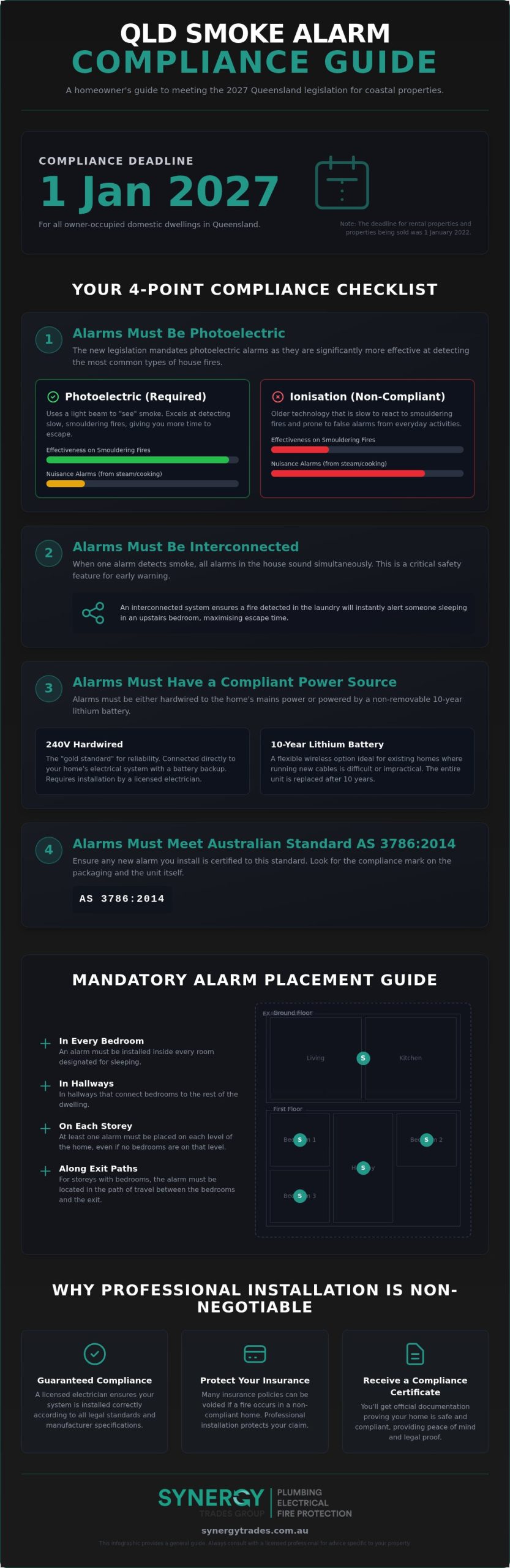
To be compliant, your alarms must be interconnected. This means when one unit detects smoke, every alarm in the house sounds simultaneously. This network ensures that a fire starting in a downstairs laundry will immediately wake someone sleeping in an upstairs bedroom. All hardware must also meet the AS 3786:2014 standard, which you can verify by looking for the specific mark on the unit. For most homeowners, 240V hardwired alarms remain the gold standard for reliability, though 10-year non-removable lithium battery units are often used in areas where running new cables is impractical.
Landlord vs Owner-Occupier Obligations
If you’re a landlord, your deadline has likely already passed. Since 1 January 2022, all rental properties and properties being sold have been required to meet these stringent standards. For owner-occupiers, you have until the 2027 deadline, but you must still ensure your alarms are tested and cleaned at least once every 12 months. Keeping a record of these tests is vital. When the time comes to sell or renew your insurance, having a compliance certificate from a licensed electrician provides the legal documentation needed to prove your home is a safe environment. As a landlord, staying on top of all your compliance obligations — including obtaining Water Efficiency Certificates to legally pass on water consumption charges to tenants — is essential for protecting your rental yield.
Photoelectric vs Ionisation: Choosing the Right Technology for Coastal Conditions
Living on the Sunshine Coast means enjoying the sea breeze, but that same salt air and high humidity can play havoc with home safety equipment. When selecting coast smoke alarms, the technology inside the unit matters just as much as where you place it. For years, ionisation alarms were the standard, but they’ve proven less effective at detecting the types of fires most common in modern Australian homes. These older units are being phased out in favour of photoelectric technology, which is better suited to our local climate and building styles.
Photoelectric sensors work by using a light source and a light-sensing chamber. When smoke enters the chamber, it scatters the light, which then triggers the alarm. This is particularly effective for detecting smouldering fires, such as those caused by electrical faults or cigarettes on furniture, which can produce thick smoke for hours before bursting into flames. Ionisation alarms, by contrast, are better at detecting fast-flaming fires but often struggle with the slow-burning, smoky fires that pose the greatest risk to sleeping occupants.
One of the biggest frustrations for local homeowners is the “nuisance alarm.” In our humid subtropical environment, steam from a hot shower or burnt toast can easily trigger older sensors. Photoelectric units are generally more stable in these conditions. They’re less prone to false triggers from moisture or cooking fumes, meaning you’re less likely to deal with a piercing siren every time you boil the kettle or open the bathroom door on a rainy day.
Why Photoelectric is the Law
Photoelectric technology is the mandatory Queensland standard because it provides superior detection of smouldering fires. This shift is a global trend driven by safety data showing that photoelectric sensors give residents more time to evacuate safely. By focusing on light scattering rather than radioactive ionisation, these alarms provide a more reliable early warning. They’ve become the non-negotiable choice for anyone looking to meet the 2027 compliance requirements.
Combatting Humidity and Pests
The Sunshine Coast climate presents unique challenges, specifically high moisture levels and small insects like thunderflies. High-quality modern sensors now include specialised bug screens to prevent pests from entering the sensing chamber and causing false alarms. Regular maintenance is still essential; a quick vacuum around the outside of the unit every few months helps keep the sensor clear of salt crust and dust. If you’re concerned about the reliability of your current units, our team can assist with smoke alarm installation and testing to ensure your system is robust enough for coastal life.
Hardwired vs Wireless Interconnected Alarms: Which System Suits Your Home?
Deciding between a hardwired or wireless setup is often the most significant choice you’ll make when upgrading your coast smoke alarms. While both methods satisfy the 2027 Queensland legislation, they offer different benefits depending on your property’s age and layout. The goal is to create a seamless network where every unit communicates perfectly. This ensures that if smoke is detected in a distant laundry or garage, the alarm in your bedroom triggers instantly to give you those vital extra seconds.
The choice usually comes down to the physical constraints of your house. For some, the decision is made by the building’s structure, while for others, it’s a balance between upfront installation costs and long-term maintenance. Understanding how these systems differ will help you choose the most reliable protection for your family.
240V Hardwired Systems: The Professional Choice
New homes and significant renovations in Queensland are required by law to use 240V hardwired smoke alarms. These units are connected directly to your home’s electrical skeleton, providing a permanent and highly reliable power source. They also include a backup battery to ensure they keep working during a power outage. Because they’re physically wired together, the interconnection is robust and less susceptible to signal interference. While the initial installation requires a licensed sparky to run cables through your ceiling, it’s a “set and forget” solution that offers the highest level of peace of mind for permanent dwellings.
Wireless RF Interconnection: The Retrofit Solution
Wireless systems use Radio Frequency (RF) signals to “talk” to each other without the need for new internal wiring. These are often the ideal choice for older multi-storey “Queenslanders” or homes with flat roofs where ceiling access is restricted. These units typically feature a non-removable 10-year lithium battery. It’s a common misconception that these are DIY items; while they don’t require mains wiring, they still need to be professionally commissioned to ensure the RF signal is strong enough to reach every corner of the house. You should also remember that “10-year” refers to the maximum life of the battery under perfect conditions. In our humid coastal environment, you’ll still need to test and clean them annually to ensure they reach that milestone.
In many larger Sunshine Coast homes, a hybrid system provides the best of both worlds. We can often link your existing 240V alarms in the main living areas to new wireless units in the bedrooms using a bridge or gateway device. This approach keeps your costs down while ensuring you meet the “every bedroom” rule. While hardwired systems involve more labour initially, they often have lower lifetime costs because you aren’t replacing expensive lithium units every decade. Weighing up these options is much easier with a professional assessment of your roof space and existing electrical board.
Strategic Placement and Maintenance: Ensuring 100% Coverage
Installing the right technology is only half the battle. For your coast smoke alarms to function effectively, they must be positioned where they can detect smoke at the earliest possible moment. The 2027 Queensland legislation is very specific about these locations. It moves beyond the old “one in the hallway” approach and mandates a comprehensive network that covers every sleeping area and the paths leading away from them.
One common mistake in Sunshine Coast homes, particularly those with vaulted ceilings or open-plan designs, is placing units in “dead air” zones. These are pockets of still air, usually in the corners of rooms or the very apex of a high ceiling, where smoke cannot easily reach the sensor. To ensure your family’s safety, alarms should generally be installed at least 300mm away from any wall or light fitting. You must also keep them clear of air-conditioning vents and ceiling fans, as the moving air can push smoke away from the alarm during a real emergency.
Where Alarms MUST Be Installed
In a standard three-bedroom home, the law now requires an alarm in every single bedroom. Additionally, you must have an alarm in the hallway that connects these rooms. If your home has multiple storeys, there must be at least one alarm on every level, even if there are no bedrooms on that floor. These must be placed along the most likely path people would take to exit the building. While it’s tempting to put an alarm in the kitchen or near the bathroom for extra safety, this often leads to frustrating nuisance alarms from cooking fumes or shower steam. It’s better to place them just outside these high-moisture areas to maintain reliability.
The Homeowner’s Maintenance Checklist
Maintaining your system is a legal requirement for both landlords and owner-occupiers. A simple monthly test by pressing the “test” button ensures the siren and interconnection are still active. Because our coastal air is filled with salt and dust, we recommend vacuuming around the sensor vents every six months to prevent build-up. If you hear a short, intermittent chirp, don’t ignore it. A single chirp every minute usually indicates a low battery, while a different pattern might mean the unit has reached its 10-year end-of-life and needs immediate replacement. For total certainty and to satisfy your insurer, booking a professional for smoke alarm installation and testing provides you with a formal compliance certificate and ensures every unit is positioned for maximum protection.
Professional Installation and Testing: Why a Licensed Electrician is Non-Negotiable
While some home maintenance tasks are perfect for a weekend DIY project, upgrading your coast smoke alarms isn’t one of them. In Queensland, the law is very clear: any work involving 240V mains power must be carried out by a licensed electrician. Attempting to install or even modify a hardwired alarm yourself isn’t just a safety risk; it’s a legal one that could result in significant fines. Beyond the law, there’s the matter of your home insurance. In the event of a fire, an insurer will look for a professional compliance certificate to prove that your safety systems met the 2027 standards. Without that paper trail, you might find your claim is compromised, leaving you with a financial burden far greater than the cost of a professional installation.
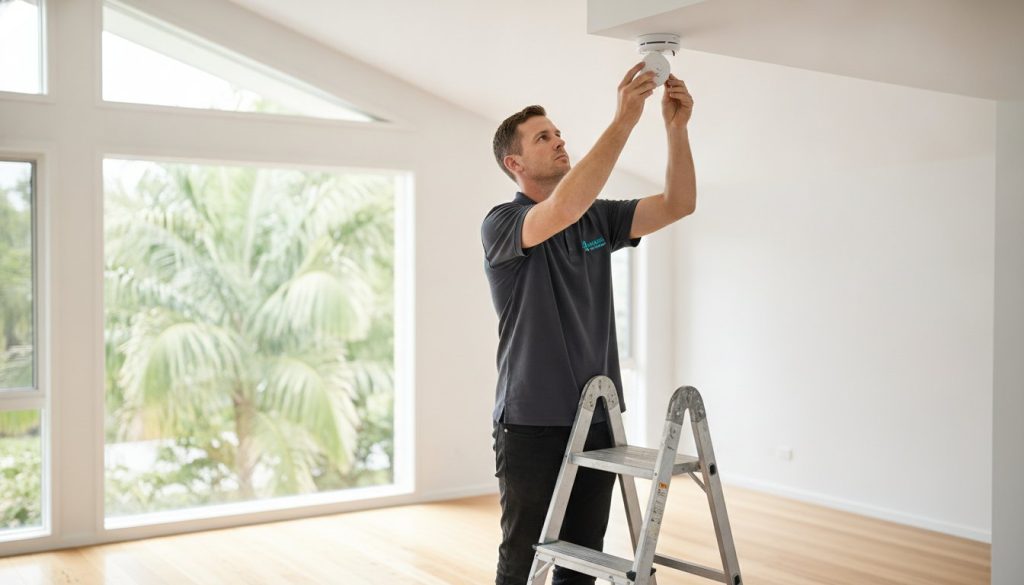
A licensed sparky does more than just screw a unit to the ceiling. We ensure the interconnection signal is strong throughout the property, verify that the sensors are clear of “dead air” zones, and confirm that the circuit is properly protected. This professional oversight gives you the peace of mind that when your family is asleep, the technology you’ve invested in will actually do its job. It’s about moving from “hoping” you’re safe to “knowing” you’re compliant. By having a professional handle the installation, you’re also guaranteed that the hardware used meets the AS 3786:2014 standard required for legal compliance.
More Than Just Alarms: The Safety Switch Connection
When we visit a home for a smoke alarm audit, we don’t just look at the sensors. We take a holistic view of your property’s electrical health. A critical part of this process is reviewing your safety switch installation. Safety switches, or RCDs, are designed to prevent electric shocks by cutting power in milliseconds if a fault is detected. Since the new smoke alarm laws often require upgrades to your switchboard or new cabling, it’s the perfect time to ensure your safety switches are up to current standards. Many older Sunshine Coast properties still rely on outdated protection; combining these services ensures your entire early-warning and protection network is robust and modern.
Choosing Synergy Trades for Your Coast Smoke Alarms
With over 70 years of combined industry experience, Synergy Trades Group has become a trusted pillar of the Sunshine Coast community. We understand the local conditions, from the salt air in Mooloolaba to the humidity in the hinterland, and we choose hardware that can stand up to the challenge. Our approach is built on transparency and reliability. We offer clear, fixed-fee pricing for our compliance audits and installations, so you won’t be met with any nasty surprises after the work is finished.
As the 1 January 2027 deadline approaches, demand for qualified electricians is expected to skyrocket. Booking your compliance check now allows you to avoid the last-minute rush and ensures your home is protected well ahead of the legal cutoff. We pride ourselves on punctuality and clear communication, making the path to compliance as smooth and stress-free as possible for your family. Don’t leave your safety to chance; let a local expert guide you through the final countdown to 2027.
Protect Your Home and Family Well Ahead of 2027
The transition to the new Queensland smoke alarm standards represents a significant step forward for household safety on the Sunshine Coast. By prioritising photoelectric technology and ensuring every bedroom is part of an interconnected network, you’re providing your family with the earliest possible warning during an emergency. It’s clear that while the 1 January 2027 deadline seems far away, taking action now avoids the stress of last-minute shortages and ensures your home insurance remains fully valid. Upgrading your coast smoke alarms is about more than just ticking a compliance box; it’s about the long-term security of your most valuable asset.
As a Sunshine Coast local family business with over 70 years of combined industry experience, our licensed electrical professionals are here to help you navigate these changes with ease. We don’t just install hardware; we provide a comprehensive compliance certification that gives you total peace of mind. We’ll ensure your system is positioned correctly and functioning perfectly, so you can sleep soundly knowing your home is protected to the highest standard.
Ready to make your property compliant? Book Your Sunshine Coast Smoke Alarm Compliance Check Today and let our expert team handle the details for you. It’s a simple step that makes a world of difference for your home’s safety.
Frequently Asked Questions
When is the actual deadline for the new smoke alarm laws in Queensland?
The final deadline for owner-occupied dwellings to comply with the new Queensland legislation is 1 January 2027. If you’re renting out your property or putting it on the market, you must already meet these standards. Acting early ensures you avoid the inevitable rush as the 2027 cutoff approaches, giving you more time to secure the right hardware and a qualified local electrician who understands the regional requirements.
Do I really need a smoke alarm in every single bedroom?
Yes, the new legislation mandates that a compliant photoelectric smoke alarm must be installed in every bedroom. This ensures that if a fire starts while you’re sleeping, the alarm will sound exactly where you need to hear it most. These units must be interconnected with all other alarms in the home, so every person in the household is alerted regardless of where the smoke is first detected.
Can I install wireless interconnected smoke alarms myself?
While you can physically mount battery-powered wireless units, professional installation is highly recommended for proper commissioning. A licensed electrician ensures the Radio Frequency signal is strong enough to link all your coast smoke alarms into a reliable network. If your home requires 240V hardwired units, it’s a legal requirement in Queensland that a licensed sparky performs the work to ensure the system is safe and compliant.
What is the difference between hardwired and 10-year battery alarms?
Hardwired alarms are connected directly to your home’s 240V electrical system and include a backup battery for power outages. They’re often the most reliable long-term solution for modern homes. In contrast, 10-year battery alarms rely on a non-removable lithium battery. These are excellent for retrofitting older homes where running new cables is difficult, though the entire unit must be replaced once the battery reaches its end-of-life milestone.
How often do I need to test my interconnected smoke alarms?
You should test your smoke alarms once a month by pressing the test button to ensure the sirens and the interconnection are functioning. It’s also vital to clean the units every six months with a vacuum to remove dust or insects that might cause false triggers. For landlords, a professional compliance test is required at the start of every new tenancy or lease renewal to meet your legal safety obligations.
Will my current smoke alarms work with the new interconnected ones?
It’s very unlikely that your existing alarms will be compatible with modern interconnected systems unless they were recently installed to the current standards. Older ionisation alarms cannot communicate with new photoelectric units. To ensure your home is fully protected, it’s usually best to replace all units at once so they can talk to each other seamlessly on the same frequency or through the same wiring network.
What happens if I sell my house and the smoke alarms aren’t compliant?
If you sell your property, you’re legally required to lodge a Form 24 with the Titles Registry stating that compliant smoke alarms are installed. Failing to do this can lead to delays in the settlement process or even legal action from the buyer. Ensuring your home meets the 2027 standards before listing it for sale provides a smoother transaction and gives the new owners peace of mind about their safety.
Why does my smoke alarm keep going off when I’m cooking?
Frequent false alarms during cooking are usually caused by an alarm being placed too close to the kitchen or using outdated ionisation technology. Photoelectric coast smoke alarms are generally better at ignoring cooking fumes while still detecting real fire hazards. If your alarm is positioned in a direct path of steam or smoke from the stove, moving it slightly further away can solve the problem without compromising your coverage.